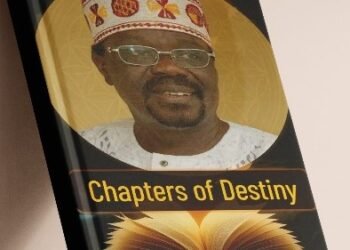
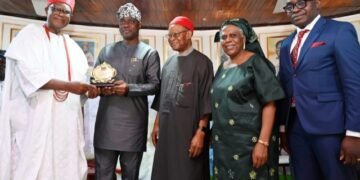
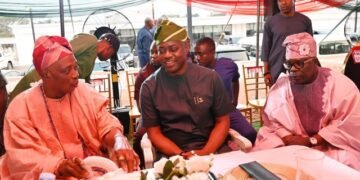








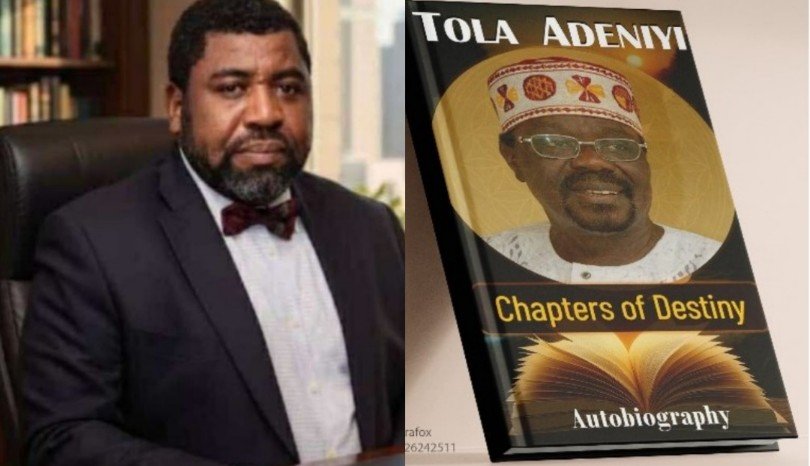
“At the recent launch of Chapters of Destiny, the autobiography of Tola Adeniyi, I had the honour of introducing the reviewer, Professor Anthony Kila.”
•Reflections from the review of Tola Adeniyi’s autobiography at its recent launch.
At the recent launch of Chapters of Destiny, the autobiography of Tola Adeniyi, I had the honour of introducing the reviewer, Professor Anthony Kila. In that introduction, I described him as “a scholar, public intellectual, and an engaging voice in policy conversations.” Indeed, Professor Kila is widely known for his work in political economy, governance, and strategy.
I also noted that he brings to intellectual fora, “academic depth, and the rare ability to interrogate ideas in ways that are both rigorous and accessible.”

I ended my remarks with a projection: we looked forward to his insights, to what he would see, what he would question, and what he would amplify within the pages of the work.
That expectation was justified because Professor Kila, who serves as the Secretary-General of the Nigerian League of Columnists, approached the book with the disciplined curiosity of a scholar and the clarity of a seasoned commentator.
His opening observation immediately commanded attention:
“Chapters of Destiny, the autobiography of Tola Adeniyi . . . is not merely the recollection of a long life well lived; it is a cartography of Nigerian public life drawn by someone who stood close enough to power to understand it, yet far enough away to resist it.”
As a book reviewer myself, I thought that was a worthy teaser.
Then he deepened the intrigue with another observation:
“This book documents and unveils something many of us had an idea of but maybe lack details about: Yes, I refer to the life of Akogun Tola Adeniyi, who, as the book unambiguously shows us, has been a leading part of many things—journalism, theatre, public service, exile, faith, agitation—but never small, never conformist, never ordinary. And it is this refusal of smallness that animates the book.”
At that point, despite little distractions that come with being a compere, he had my full attention.
Professor Kila engaged the book thoroughly. His review was insightful, cutting through the narrative with a clinical yet relatable clarity. He sprinkled it with his own thoughts which were also words on marble.
Hear him:
“Akogun Adeniyi’s immersion in drama, poetry, and public speaking becomes the training ground for later confrontations with power. He learns early that audiences matter—but so does integrity. He teaches us a lesson: Popularity is never allowed to replace truth.”
Aba Saheed was a watershed in the life of the author, it was the persona he donned when the road became precarious as a journalist-activist-crusader. Professor Kila delivered a tantalising analysis there.
Hear him:
“It is in the creation and flourishing of the Aba Saheed persona that Adeniyi’s moral courage is most clearly on display. Aba Saheed was not a mask meant to conceal; no fear, no shame, rather it was a voice meant to sharpen perception.
“Through satire and caustic commentary, Chief Adeniyi confronted both military and civilian regimes with an audacity that now feels almost unimaginable.”
By then, I felt the review was fascinating enough to awaken a reader’s desire to encounter the author directly through the pages of the autobiography.
Curious to revisit those insights, I later requested the full text of his review. What stood out in particular, as I read through, were several philosophical reflections drawn from the book. They were lines that carry the weight of lived experience and contemplation.
The same lines that got me nodding and muttering “uhmn!” under my breath in the hall. They capture the tone of Adeniyi’s journey and the themes Professor Kila found most compelling…
1. “The Self-Manifest gave every creature free will, and thereafter placed the world on auto-drive: choose your path, and bear the consequences.”
2. “Fate began to show its powers in my life very early, long before I knew its name or understood its temper.”
3. “I learned early that education is not a contest between cultures, but a conversation between worlds.”
4. “Words discovered me before I discovered words; once they did, there was no retreat.”
5. “The Press is never dangerous to a just government; it is lethal only to fear, incompetence, and deceit.”
6. “To be silent in the presence of injustice is not neutrality; it is collaboration.”
7. “A nation that forgets its storytellers will soon lose the story of itself.”
8. “God does not punish man; man punishes himself by the choices he makes while blaming heaven.”
9. “Exile is not the absence of home; it is the discipline of remembering who you are without applause.”
10. “I did not live to be liked by power; I lived to remain at peace with my conscience.”
11. “Exile teaches you the difference between recognition and relevance; one is noisy, the other enduring.”
12. “Distance did not weaken my attachment to Nigeria; it purified it of impatience.”
13. “Nations do not fail because of wicked individuals alone; they fail because weak institutions learn to tolerate them.”
14. “Freedom without responsibility is not liberty; it is abandonment.
15. “We mistake movement for progress because standing still would require reflection.”
16. “Age does not make one wiser by default; it merely removes the excuse of ignorance.”
17. “I sought coherence, not applause; and I learned that the two rarely arrive together.”
18. “I wrote because silence would have been easier—and therefore unforgivable.”
19. “Destiny does not announce itself; it waits patiently for our decisions to give it meaning.”
I marveled at the enigma that the octogenarian is and wondered what a task it would be to condense his illustrious, high octane, full life into a book.
I also, frankly, didn’t envy Professor Kila’s arduous duty of reviewing the book of such a complex, and extremely high-achieving persona.
Ultimately, his review leaves the reader curious about the autobiography itself, and reflective about the choices, convictions, and circumstances that shape that consequential life.
•Fúnké-Treasure is a thinker, strategist and communicator.