












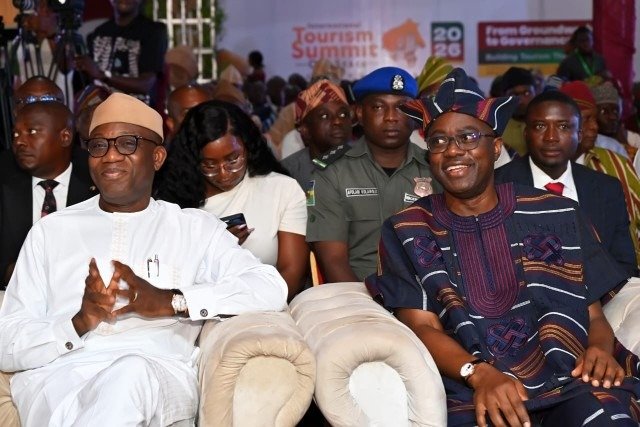
Ahead of the 2027 elections, Oyo State governor ‘Seyi Makinde, has urged the people to support continuity in the interest of the state, declaring that the impact of the mistake of a one-day event will last for four years.
He made the declaration on Wednesday while speaking at the International Tourism Summit Oyo State 2026, held at the International Conference Centre, University of Ibadan.
The 2026 edition of the summit had the theme, “From Groundwork to Governance: Building Tourism That Endures.”
Makinde said leadership does change but systems endure, adding: “When we assumed office, we understood that progress driven solely by leadership is not enough, because leadership changes.
“I have told the people that I will recommend for the people of Oyo State, but the decision will rest with the people of the state. If we make a mistake, it is a one-day event, but the impact will last four years. So, we must get it right.”
Speaking further on continuity, the governor maintained that, as he had said on many occasions, he would recommend an individual to the people of the state, who would then decide who to vote for as the next governor.
He, however, added that such recommendation will be influenced by loyalty to Oyo State and capacity to move the state forward, rather than political party colouration.
He restated that his administration has been able to achieve success because it was blind to party affiliations and mainly focused on the development of the state.
“For us, if you are from Oyo State, and you are loyal to Oyo State, and you have faith in your state, and you have the capacity, we will tap you to support the development of Oyo State.”
Makinde said what his government was trying to achieve with regards to continuity was to push for a state “where the future administrations will not need to begin again.
“They will be able to build on what exists because the foundation has been properly laid. And this is what we mean when we say from groundwork to governance.
“We have moved beyond identifying opportunities. We are now building systems that will sustain them,” Makinde added.
Governor Makinde also explained that his administration has put in place major policies, actions and economic enablers that will make the Pacesetter State the hub of tourism in South-West Nigeria and a major tourism destination in the country.
He noted that, with key infrastructure development projects connecting towns and communities in the state, improved security as well as ongoing efforts to revitalise major tourist attractions, the number of tourism activities in Oyo State will increase in the next few years.
The governor said another major factor that will make the state a tourism hub was in the area of continuity of policies and ideas.
According to him, policies underpinning tourism development have been institutionalised, with structures and systems well built and ideas aligned to sustain the sector.
Makinde further said his administration has been showcasing tourism assets and building structures to institutionalise them beyond his term in office.
This, he said, was done with an approach that was deliberate and strategic, beyond initiating projects, but rather focused on building structures capable of sustaining long-term growth in the tourism sector.
Makinde added that his administration has created a system where investment is not only possible but structured, protected and enduring for investors in the state.
He urged investors to nurse no fear about leadership changes, declaring that the people of Oyo State will support members of his team in the next election cycle in order to sustain policies and ideas that have worked out well in the interest of the state.
Earlier in his remarks, former Minister of Mines and Steel, Dr Kayode Fayemi, commended Governor Makinde for the infrastructural strides across all parts of the state.
Fayemi, a former governor of Ekiti State, also appreciated Makinde for promoting tourism and for implementing the African Continental Free Trade Area initiative.
He urged the governor to embrace continuity as a development strategy, stressing that sustained policies and governance are essential for meaningful development.
Reflecting on his experience, Fayemi said for tourism to be sustained and developed “it must be institutionalised rather than personalised; serve as a catalyst instead of a controller;
“It must be treated as an ecosystem rather than isolated projects; must be recognised as an economic driver and not merely decoration; and security alongside environmental stewardship must remain non-negotiable.”
He called for the establishment of a South-West Tourism Circuit that would serve as the region’s international gateway for tourism, with the tourist attractions of each state strategically interconnected.