















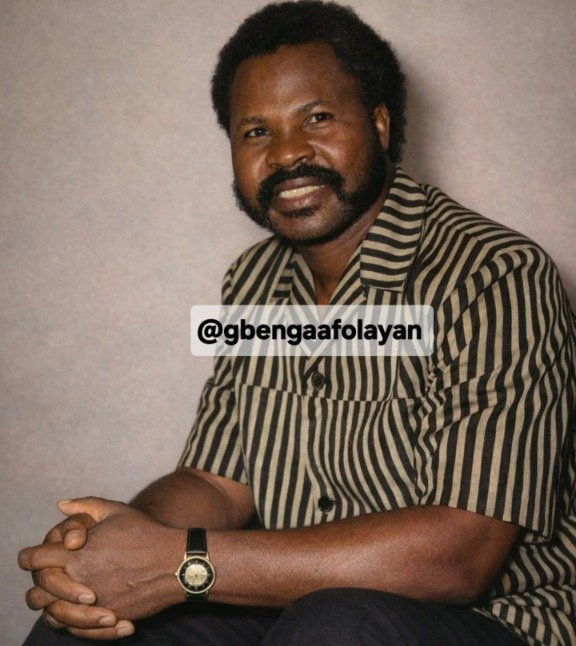
There are some singers whose songs entertain a season, and there are some whose voices outlive their own time. Late Evangelist Bayo Adegboyega belonged to the second group. He was not merely a Yoruba gospel musician with a memorable sound. He was a minister whose songs carried warning, comfort, conscience, and conviction.
Born in 1956. He was reportedly an indigene of Ogun State. He rose to public prominence in the 1980s and became one of the enduring voices of indigenous Yoruba gospel music. He died on 7 April 2008 at the age of 52, but the force of his message has remained far beyond his lifetime.
Bayo Adegboyega Did Not Just Sing, He Preached
What set Bayo Adegboyega apart was that he did not treat gospel music as mere performance. He used it as ministry. Scholarly work on his legacy describes him not only as a gospel artiste, but also as an evangelist, preacher, moralist, and social crusader whose music addressed salvation, holy living, prayer, and the fear of God, while also confronting corruption, hardship, insecurity, bad leadership, and the moral condition of the nation. That is why his songs carried unusual weight. He was singing, but he was also teaching. He was entertaining, but he was also confronting.

Bayo Adegboyega Sang The Gospel In The Language Of The People
One of his greatest strengths was his ability to speak deep spiritual truth in simple, accessible Yoruba. He did not hide the gospel behind complexity. He brought it close to the people. His songs sounded like the language of the Church, the home, the market, and the street, yet they carried the seriousness of a sermon. This was part of his power. He proved that Yoruba gospel music could be spiritually rich, morally sound, and socially relevant all at once. His message was local in language, but broad in meaning (live right, fear God, treat people well, leaders should govern well and we should all remember that life is brief).
The Song That Became His Identity
His major breakthrough came in 1986, when he came into limelight with Atayero Bi Agogo, a work so influential that it effectively became part of his public identity. From that period, many people simply knew him as Atayero. The success of that moment was closely tied to Oro Aye Nfe Adura, one of the key recordings associated with his rise.
Apple Music and other catalog records date that album to 1986, reinforcing the timeline given in the scholarly account. This was not fame built on noise alone. It was a breakthrough built on message, memory, and moral force.
More Than A Hitmaker, Bayo Adegboyega Built A Body Of Work
Bayo Adegboyega was never just a one-song figure. He produced several albums. Among the titles associated with him are Atayero Wa, Itunu, Dear Mother, Oko Naijiria Ree Loju Agbami, Ebute Ayo, Oro Aye Nfe Adura, and Ilu Le.
Music catalog records also preserve releases such as Oro Aye Nfe Adura from 1986, Ilu Le from 1988, Ebute Ayo (Oko Nigeria) from 1989, and Dear Mother from 1992, helping to confirm both the breadth and continuity of his musical ministry.
When Nigeria Was In Pain, Bayo Adegboyega Gave It A Voice
One of the most striking features of Adegboyega’s ministry was his willingness to sing about Nigeria’s condition. He was not content to sing only about heaven while ignoring the suffering on earth. His music addressed the hardship of ordinary life, the failures of leadership, the spread of corruption, the problem of insecurity, unemployment, and the longing for a better nation. The scholarly study on his work notes clearly that he followed governance issues closely and offered godly counsel through song. In that sense, he stood as more than a gospel singer. He became a moral voice in public life.
Ilu Le Was More Than A Song, It Was A Social Mirror
Songs like Ilu Le remain powerful because they did more than describe suffering. They interpreted it. In that song, Adegboyega turned the hardship of Nigeria into a lament, a warning, and a moral diagnosis. He understood that national pain was not only economic; it was also spiritual and political. That is why the song has remained memorable long after its release. It continues to resonate because the burden it named did not disappear with time. It spoke to a people living under pressure and longing for relief, justice, and godly direction.
Bayo Adegboyega Carried The Pulpit Beyond Church Walls
Adegboyega’s ministry was not restricted to studio recordings. He was known for ministering at crusades, concerts, church programmes, and revival gatherings, which helps explain why his music spread so deeply among ordinary listeners. He belonged to a generation of indigenous Christian ministers who helped move gospel music beyond the inner circle of church worship into wider public life. His songs could be heard as prayer, as warning, as counsel, and as social reflection. That broad reach helped make his music part of both Christian devotion and public memory.
A Christian Voice Beyond Denominational Labels
What can be said with confidence is that Bayo Adegboyega was a committed Christian evangelist and Yoruba gospel minister whose songs and ministrations cut across church programmes, revival grounds, and the wider society. The strongest available sources do not firmly establish a specific denominational identity such as Celestial Church of Christ (CCC) or another named church tradition.
It is therefore safer and more accurate to remember him in the wider space he clearly occupied: a gospel witness whose message reached beyond one corner of the Church into the public conscience of the people.
His Death Was Painful, But His Message Was Not Buried
Late Bayo Adegboyega died in Ibadan on Monday, 7 April 2008, after a prolonged battle with diabetes. The strongest academic source states that the illness was severe and that it eventually cost him his sight before his passing. He died at the age of 52, and his death was a painful loss to Yoruba gospel music and to those who had followed his ministry over the years. Yet his passing did not bury his songs. In many ways, it sharpened their meaning. A voice that had long warned, prayed, and pleaded with society suddenly became part of memory, and memory gave the songs fresh life.
Why His Songs Still Live On
The continued relevance of Bayo Adegboyega’s music is not difficult to explain. His songs survive because they were built on truth. They addressed realities that still trouble society: hardship, false leadership, moral decline, family strain, and the human need for God. His catalog remains available across modern music platforms, and his work continues to draw scholarly attention as an example of gospel music that was spiritually grounded and socially awake. That kind of legacy does not fade easily.
He Is Gone, But His Voice Still Speaks
Late Evangelist Bayo Adegboyega may be gone, but his voice still speaks. It speaks not only through memory, but through contrast. It reminds us of a time in Yoruba gospel music when songs were not built mainly around charts, streams, branding, or performance metrics, but around burden, message, melody, scripture, and moral responsibility.
In Bayo Adegboyega’s body of work, one hears more than music. One hears a minister who understood that gospel song was first a calling before it became a career.
His lyrics were simple, but never shallow. His melodies were accessible, but never empty. His percussion and instrumental flow carried the familiar strength of indigenous Yoruba gospel tradition, yet they were always in service of the message, never in competition with it. The rhythm supported the word. The melody carried conviction. The music did not bury the truth. It delivered it.
This was one of the enduring strengths of the Yoruba gospel tradition that matured across the 1970s, 1980s, and 1990s, when many gospel ministers saw music as preaching, warning, teaching, prayer, and social witness all at once.
Songs were expected to carry biblical weight, moral clarity, spiritual fire, and human meaning. They addressed heaven, but they also addressed the earth. They spoke about Christ, sin, mercy, righteousness, family life, death, accountability, leadership, and the fragile condition of society.
That is why Bayo Adegboyega could sing about prayer and still sing about governance. He could sing about eternity and still confront corruption, hardship, and the suffering of ordinary people. His Christianity was not decorative. It was applied. His gospel was not designed merely to make people feel good. It was meant to make people think right, live right, and turn back to God.
That is where his music stands as a quiet rebuke to much of today’s gospel culture. Not all contemporary gospel music is shallow, but too much of it is increasingly shaped by visibility, applause, commercial packaging, social media optics, and the economics of streaming. In many cases, lyrical depth has given way to repetition without revelation. Sound has become louder, but substance thinner.
Performance has expanded, but conviction has weakened. The market now often rewards whatever is catchy, emotionally immediate, and algorithm-friendly, even when it lacks scriptural seriousness, theological depth, poetic discipline, or social conscience.
By contrast, Bayo Adegboyega belonged to a school of gospel expression in which the singer was expected to be more than a vocalist. He was expected to be a witness, a moral teacher, and a servant of truth.
Today’s gospel musicians have much to learn from that older tradition and from Bayo Adegboyega in particular. They can learn that the melody must not outrun the message. They can learn that instrumentation, however rich, should not overshadow the burden of the song. They can learn that biblical truth is not an obstacle to musical excellence, but its deepest anchor.
Today’s musician can learn that gospel music can be spiritually alive and socially relevant at the same time. They can learn that one does not need to choose between artistic beauty and moral seriousness. They can learn to sing not only for attention, but for transformation; not only for consumption, but for conviction; not only to trend, but to testify.
This is why Bayo Adegboyega still matters. He was more than a singer. He was a gospel witness whose music carried Christ, conscience, warning, comfort, and hope. He sang for the Church, but he also sang for the nation. He sang for the soul, but he also sang for the home. He may have left this world, but his message did not leave with him.
In an age where much music is quickly made and quickly forgotten, his legacy reminds us that the songs that endure are the ones built on truth, burden, and spiritual integrity. For that, Bayo Adegboyega deserves to be remembered not merely with nostalgia, but with honour, gratitude, and deep respect.
May your soul continue to rest in peace.
•Source: Manuel-F Media (Facebook)