












As the 2026 farming season begins, the Oyo State government has counseled farmers in the state to take advantage of weather forecasts, and the state’s 50 per cent tractorisation subsidy programme.
It tasked farmers to avail themselves of opportunities provided by the state Ministry of Agriculture and Rural Development in the areas of credible weather forecasts from the Nigerian Meteorological Agency (NiMet) and the state’s tractorisation subsidy programme.
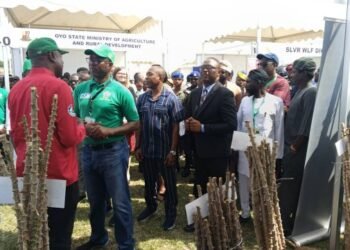
Commissioner for Agriculture and Rural Development, Olasunkanmi Olaleye, gave the advice at the official flag-off of the 2026 farming season, held at the Local Government Training Hall, State Secretariat, Agodi, Ibadan.
The event was attended by stakeholders in the agriculture sector in the state, as the commissioner lauded the Governor ‘Seyi Seyi Makinde administration’s commitment to supporting farmers and ensuring food security.

The commitment, he said, led to the introduction of the 50 per cent tractorisation subsidy under the Sustainable Action for Economic Recovery (SAfER), the conduct of a digital soil test and other initiatives in the agriculture sector.
Olaleye explained that access to reliable weather forecasts would enable farmers to make informed decisions during their farming activities.
He added that the 50 per cent subsidy on the cost of hiring tractors will ease the burden of farmers on land preparation, which is a key component of farming.
The commissioner noted that the Oyo State government has recorded significant progress in the agricultural sector through these interventions.
“It is my great honour to welcome you all to this crucial gathering convened to advance our agricultural sector through strategic measures aimed at mitigating the effects of weather and climate change.
“The annual seasonal climate prediction serves as an indispensable early warning system, providing vital information on the outset and cessation of rainy season, the change in atmospheric conditions, annual rainfall projections, potential dry spell occurrences and temperature variations.
“According to the 2026 seasonal climate prediction by the Nigerian Meteorological Agency (NiMET), Oyo State will experience very dry spell conditions across the different local government areas.
“Today’s sensitisation on weather forecasting formally marks the commencement of another agricultural planting season calendar.
“Our primary objective is to equip our farmers with essential knowledge regarding weather predictions that will significantly influence agricultural production throughout the state, thereby ensuring they are well prepared for a productive and successful planting season.
“Complementing these efforts, I am pleased to formally flag off the 50 per cent Tractorisation Subsidy Programme under the Sustainable Action for Economic Recovery initiative, SAfER, and to share with you the progress, impact and future direction of this transformative programme.
“Agriculture remains the backbone of the economy of Oyo State, employing thousands of smallholder farmers and contributing significantly to food supply and rural livelihood.
“However, land preparation has traditionally been labour-intensive, time-consuming and costly, limiting productivity, reducing farm sizes and constraining food output.
“To address these challenges, the Government of Oyo State introduced the 50 per cent Tractorisation Subsidy Programme, under which the state government subsidises 50 per cent of the cost of land ploughing, making mechanised farming more accessible, affordable and efficient for our farmers.
“The objectives of this programme are clear, to reduce the cost of land preparation for farmers, to promote mechanised farming for increased productivity and higher yield, to improve the income of smallholder farmers, and to encourage the adoption of modern agricultural practices through strengthened extension support services.
“This programme commenced in 2024, and within a short period, remarkable achievements were recorded.
“At the end of 2024, the programme had registered 20 tractors and 133 booking agents. A total of 6,090 acres were successfully ploughed, at an average of 4.09 acres per farmer.
“By 2025, the programme expanded significantly as 7,261 farmers benefited, 31,723 acres of farmland were ploughed, and coverage extended to 27 local government areas of the state.
“The result on ground speaks for itself. Farmers are now cultivating large areas, planting schedules have improved, labour costs are falling, and rural economic activity has been stimulating to tractor operators and booking agents across the state.
“Beyond the numbers, this programme represents hope, the hope for greater prosperity for our farmers, and sustainable agricultural development for our state.
“While we celebrate this achievement, we remain firmly committed to increasing the number of registered tractors and operators, sustaining and deepening coverage across all the 27 agrarian local government areas.
“We remain committed to strengthening monitoring, and transparency in booking and payment, and building strategic partnerships to further scale our economy.
“Our goal is simple and non-negotiable. No willing farmer should be left behind. When every single climate prediction is combined with expanded mechanisation, we create a powerful synergy.
“Our farmers will not only know what to plant and when, they will have the tools to plant efficiently and on time.
“With the continued support and collaboration of all stakeholders, we are firmly on course to position our state as a leader in agricultural mechanisation in Nigeria,” the commissioner stated.
He thanked Governor ‘Seyi Makinde for his unwavering commitment to boosting agriculture and enhancing the welfare of our farmers and citizens.
“His landmark initiative, the Sustainable Action for Economic Recovery (SAfER), launched in 2023, is a key pillar for food security and economic resilience.
“Equally, and very significantly, is the inauguration of the Oyo State Food Coordination Committee, which has revitalised our stakeholders’ engagement in agricultural productivity through improved access to quality seeds and capital,” he added.
Olaleye equally called on investors in the agriculture sector to give Oyo State a look-in, noting that they can access detailed soil fertility data for all rural communities and also benefit from the Makinde administration’s strong efforts in ensuring ease of doing business for all investors.
“His Excellency has overseen the implementation of digital soil testing across farmland communities designed to determine soil nutrient levels and improve soil fertility.
“This project was a collaborative effort involving the Ministry of Agriculture and Rural Development, smallholder farmers, private sector partners, and OCP Fertilizer of Africa and various community groups.
“Together, we have worked tirelessly to ensure its successful completion. The outcome of this project stands as a testament to our collective efforts.
“Among the significant milestones achieved are the documentation of soil fertility results from all rural communities across the state, the registration of 58,290 smallholder farmers, a measurable increase in farmers’ actual knowledge and crop yield, a reduction in plant-based application of fertilizer, and the promotion of sustainable agricultural practices.
“These achievements open new doors for investment and innovation. Investors can now readily access detailed soil fertility data for all rural communities, making our state an increasingly attractive destination for agricultural enterprise in our state,” he added.
Earlier, while delivering a lecture on weather forecasts for the 2026 farming season, the Oyo State Contact Person at NiMET advised farmers to plant drought-resistant seeds and adhere strictly to the rainfall predictions for the year in order to avoid losses.
He advised farmers not to be misled by the recent rainfall but to begin their planting activities towards the end of April, when the rains are expected to have properly set in.
In her welcome address, Permanent Secretary of Ministry of Agriculture and Rural Development, Mrs Abosede Owoeye, said the aim of the sensitisation programme was to bridge the gap between scientific climate information and practical agricultural decision-making.
She added that the initiative would ensure that farmers, extension officers, agribusiness operators, financial institutions and policymakers understand how to interpret seasonal climate predictions and effectively integrate them into their operational plans.