












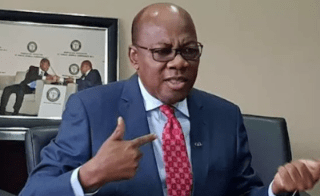
Dr Olisa Agbakoba SAN, a foremost constitutional lawyer and human rights activist, has called for the insulation of the proposed state police from executive interference.
He stated his position in a letter which he addressed to Senator George Akume, the Secretary to the Government of the Federation (SGF).
The letter, dated 26 June, 2026, was titled Beyond State Police: Why Nigeria Must Constitutionally Its Institutions From Executive Interference.

Agbakoba however commended President Bola Tinubu for transmitting an Executive Bill to the National Assembly proposing the amendment of Section 214 of the 1999 Constitution to introduce the long-awaited state police.
Agbakoba On State Police
“This is a welcome development that will, if properly implemented, enhance public security and bring law enforcement closer to the communities it serves,” he stated.
The renowned constitutional lawyer however averred that, beyond the question of state police, the moment also invited a broader conversation.
“Having devolved policing, is it not time to consider further technical devolutions such as drivers’ licences, prisons, marriage registration, arbitration, trade regulation, registration of business names, and all other matters best suited for states and local governments, so as to relieve the Federal Government of responsibilities that can be more efficiently managed at the sub-national level?
“These are reforms worth serious consideration,” he stated in the letter.
He expressed concern that the state police may go the way of some institutions established with good intentions but ultimately captured by state executives and rendered ineffective.
Such institutions he listed to include the State Independent Electoral Commissions (SIECs) and local governments, among others.
He stated that devolution without institutional protection was reform in name only, adding that history has shown that where institutions lack genuine constitutional protection, they inevitably become instruments of executive power rather than servants of the people and the Constitution.
“Nigeria need not look far for a tested solution. The Constitution of South Africa offers an instructive model.
“Chapter 9, titled “Institutions Supporting Constitutional Democracy,” establishes and protects a range of independent state institutions including the Public Protector, the Human Rights Commission, the Electoral Commission, and the Auditor General, and crucially insulates them from executive interference.
“These institutions are not merely created by statute. They derive their independence directly from the Constitution itself, with security of tenure for their heads, guaranteed funding, and accountability to Parliament, rather than to the Executive.
“The result is that in South Africa, neither the President, nor any provincial governor can dictate to or manipulate these critical institutions,” Agbakoba added.
He therefore advised Nigeria to adopt the South African model so that critical institutions currently listed under Section 153 of the 1999 Constitution as executive institutions, should be insulated from executive control and established as constitutionally protected institutions that consolidate democracy.
He listed such institutions as the Nigeria Police, INEC, EFCC, ICPC, CBN, National Judicial Council, Attorney General, Accountant General, National Human Rights Commission, Code of Conduct Bureau, and Office of the Public Defender.
“These institutions should enjoy security of tenure. Their funding should be a direct charge on the Consolidated Revenue Fund, and their accountability should be under the supervision of the National Assembly or the state Houses of Assembly, and not the president or any governor.
“This process has been described by Professor Ben Nwabueze as the concept of limited government, which is the principle that executive power is not at large but is constrained by independent institutions guaranteed by the Constitution.
“If the proposed state police framework is built on this constitutional architecture of independence and accountability, it is a welcome and progressive development.
“If not, if state police are simply handed to governors without these protections. They will inevitably become tools of oppression, and Nigeria will have traded one problem for a far worse one,” he added.
Agbakoba recommended an interlocking appointment, funding, and removal process like that which governed the judiciary, in which all three arms of government play a defined and balancing role.
Taking the state police as an example, he advised that the Police Service Commission should identify and recommend suitably qualified candidates to the governor.
The governor, he said, would exercise the power of appointment, and the state House of Assembly would confirm the appointment.
“The same tripartite structure should govern removal, so that no single arm of the government can unilaterally install or dislodge the head of the police.
“This architecture of shared constitutional responsibility is the surest guarantee against executive capture and the politicisation of law enforcement,” he noted.
He expressed the opinion that his submission will receive the attention it deserved and that the Federal Government will give serious consideration to the constitutional reforms he proposed herein.