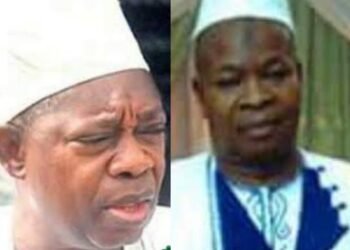






On Sunday, July 13, 2025, Muhammadu Buhari, Nigeria’s former military ruler and two-term civilian president, passed away in London at the age of 82.
With his death, Nigeria closes a defining chapter in its turbulent political history! a chapter authored by a man who embodied discipline, stoicism, and controversy in equal measure.
Born in Daura, Katsina State, in 1942, Buhari’s trajectory from humble beginnings to national leadership was shaped by military training and battlefield experience.
Buhari was among the young officers who fought in the civil war and later ascended through the ranks, eventually leading Nigeria as Head of State after the 1983 coup that toppled the Second Republic.

His 20-month military regime (1983–1985) was stern and unapologetically austere. With the War Against Indiscipline (WAI), Buhari became the face of a crusade against corruption, lawlessness, and excess. But Buhari also drew fierce criticism for authoritarianism, with journalists detained, politicians jailed without trial, and a regime that seemed allergic to dissent. He was eventually overthrown by his own military peers, but his reputation for personal integrity and spartan living endured.
Then came his political resurrection. After three failed presidential bids (2003, 2007, and 2011), Buhari won the 2015 election, defeating incumbent Goodluck Jonathan, and marking the first time in Nigeria’s history that power changed hands peacefully through the ballot box. While former President Olusegun Obasanjo had also returned as a civilian president after military rule in 1999, Buhari’s comeback was different: it was driven by a popular uprising of hope, an urgent desire for reform, and the promise of anti-corruption and national renewal.
The Buhari presidency (2015–2023) was defined by this very paradox: towering expectation and uneven delivery.
On the one hand, he oversaw critical reforms, the introduction of the Treasury Single Account (TSA), agricultural interventions, infrastructure expansion (notably in rail and roads), the Presidential Fertilizer Initiative, and modest gains in public financial discipline. He also made notable appointments in the judiciary and maintained steady foreign relations, especially with China and ECOWAS.
On the other hand, his tenure was marred by economic woes, including two recessions, soaring inflation, skyrocketing unemployment, and a rapidly devalued naira. His administration’s handling of insecurity often left Nigerians bewildered and frightened: from Boko Haram’s deadly persistence to banditry in the Northwest, kidnappings across the Middle Belt, and separatist tensions in the Southeast.
The 2020 #EndSARS movement was a generational indictment. The perceived indifference of the Buhari government to youth-led protests against police brutality culminated in the tragic Lekki Toll Gate shootings, a moment that will forever remain a moral stain on his legacy.
Beyond policy, Buhari’s presidency was criticised for ethnic and regional imbalance. Despite his 2015 declaration that he “belonged to nobody,” many Nigerians came to believe that he listened to only a few. Key national security and economic positions were concentrated in the North, heightening disillusionment in the South and East.
Yet, in death as in life, Buhari defies a simple verdict.
One achievement that must be noted, and history will be kinder to him for this, is his willingness to respect democratic succession. Despite mounting criticism of his governance, Buhari facilitated a peaceful transfer of power in 2023 to Bola Ahmed Tinubu, his long-time ally and a fellow stalwart of the All Progressives Congress (APC). It was a momentous civilian-to-civilian, party-to-party transition, one that reaffirmed Nigeria’s democratic trajectory and marked a stabilizing closure to his tenure.
In Africa, Buhari’s stature remained formidable. As ECOWAS Chair and continental elder statesman, he spoke often against unconstitutional changes of power, aligning himself with regional democratic values, even when governance back home was far from perfect.
Globally, Buhari was admired for his austere lifestyle, modesty, and anti-corruption stance, though many questioned the sincerity and even-handedness of his domestic campaign. International observers often noted the disconnect between Buhari’s image and his administration’s sometimes lacklustre performance in human rights, press freedom, and economic transparency.
So how will history remember Muhammadu Buhari?
As a man of personal discipline, yet politically rigid. As a leader who promised change but struggled to deliver transformation. As a patriot who believed in Nigeria, but who could not always unite it. As a symbol of anti-corruption, but also of economic fragility. As a quiet figure in public, but one whose silence often roared in the ears of an expectant nation.
His journey, from Daura to Dodan Barracks, from prison to the presidency, from military fatigues to civilian agbada, is one of the most fascinating arcs in Nigerian history. But the nation Buhari left behind remains as divided, restless, and aspiring as when he found it.
And yet, even amid disillusionment, his death reminds us of something deeper: that Nigeria’s search for leadership, justice, and nationhood is not yet over, and that no single man, no matter how disciplined, can carry that burden alone.
•Akinwunmi is based in Lagos.