













The Nigeria Union of Journalists (NUJ) has intensified calls for responsible journalism and ethical reporting in the face of rising insecurity and increasing trend of fake news.
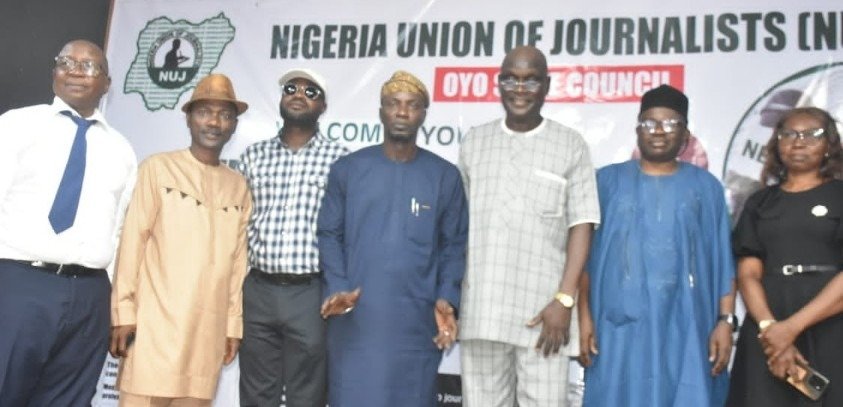
The call was made during an interventional seminar organised by the NUJ, Oyo State Council on reporting in the era of insecurity and fake news, held at the Dapo Aderogba Hall, NUJ Press Centre, Iyaganku, Ibadan, on Monday.
It was held to equip journalists with the knowledge, skills and professional guidance necessary to combat fake news, promote accurate and balanced reporting, and strengthen security-conscious journalism.

Rising Insecurity and Ethical Reporting

The seminar brought together journalists, media executives, legal practitioners, security experts, and communication stakeholders to brainstorm on the growing challenges posed by misinformation, insecurity and the implications of cybercrime laws on journalism practice.
Key discussions at the seminar focused on responsible reporting in the era of insecurity, the dangers and consequences of fake news, media ethics and professional standards.
Various speakers also spoke on understanding cybercrime laws and the legal implications of misinformation, as well as strengthening collaboration between media organisations and security agencies.
Speaking at the event, a former Chief Press Secretary to the Oyo State Governor, Taiwo Adisa (Ph.D), urged journalists to remain committed to truth, accuracy and professional integrity, regardless of prevailing pressures.
He said the reporter should be the first gate-keeper and ensure that falsehood does not gain access to the newsroom by conducting rigorous fact-checking and adherence to ethical standards of the profession.
Adisa warned against sensational reporting of insecurity, recalling instances where media reports on the Boko Haram insurgency inadvertently amplified the narratives of criminal groups through poorly-framed headlines.
Acknowledging that journalists have a duty to report security challenges, he charged them to equally hold governments accountable to their constitutional responsibility of protecting lives and property.
“Don’t be tired of saying the truth because the truth will always prevail. Journalists must continue to tell the truth and challenge governments to perform their responsibilities in securing citizens and their property,” he said.
Adisa maintained that security remained the primary responsibility of government, urging public officials at all levels to take decisive action against criminal elements threatening national security and stability.
Also speaking, Zonal Manager of the News Agency of Nigeria (NAN), Ibadan, Mr Adebayo Sekoni, highlighted the legal and ethical obligations guiding journalism practice in Nigeria.
He said there are rules and regulations that collectively regulate media operations and which placed the ethical responsibility on the journalist to verify his or her information before disseminating it through the mass media.
The rules and regulations, Sekoni said, included constitutional provisions, the Freedom of Information Act (FoI Act), the Nigerian Press Council Act, National Broadcasting Commission regulations, the Cybercrime Act and defamation laws.
Sekoni expressed concern over the increasing spread of unverified reports on social media platforms, warning that fake news often fuels panic, misinformation and social unrest.
“Sometimes it is better not to publish a story than to publish an unverified report capable of causing panic and damaging reputations,” he said.
He urged journalists to resist pressure to prioritise speed over accuracy, stressing that professional credibility should never be sacrificed for breaking news.
The NAN Zonal Manager also called on public relations officers of security agencies to respond promptly to media enquiries, noting that delayed responses often create avenues for misinformation to thrive.
He emphasised the need for conflict-sensitive reporting, respect for victims of violence and adherence to ethical standards in the use of images and videos associated with security incidents.
Earlier in his welcome address, Chairman of NUJ, Oyo State Council, Comrade Akeem Abas, said the seminar was a timely intervention to strengthen professionalism in a period dominated by fake news, cyber manipulation and unethical media practices.
He decried the proliferation of smartphones and social media platforms, noting that it has enabled individuals without professional training in journalism to disseminate unverified information capable of undermining public trust and national security.
“Fake news is not journalism. Character assassination is not journalism. Blackmail is not journalism. Reckless speculation is not journalism,” Abas declared.
Warning that careless reporting of insecurity, terrorism, kidnapping and communal conflicts could inflame tensions and endanger lives, he urged journalists to prioritise verification, fairness and responsibility before disseminating information.
While acknowledging the relevance of the Cybercrime Act in regulating digital communication, the Oyo NUJ Chairman cautioned against its misuse to intimidate journalists who were performing their legitimate and constitutional duties.
This was as he asserted that democracy can only thrive when the press remained free, fearless and responsible.
He reaffirmed the commitment of the NUJ to defending journalists against oppression and unlawful harassment, while also discouraging unethical practices disguised as journalism.
Participants were encouraged to embrace continuous professional development, improve fact-checking mechanisms and responsibly leverage on technology in order to preserve public trust and uphold the integrity of the journalism profession.
The seminar ended with renewed calls for media practitioners to serve as defenders of truth, accountability and national cohesion in an increasingly complex information environment.