














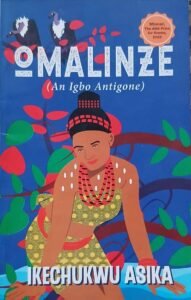
The play was winner of the ANA Prize for Drama 2022. It was published in 2023 by Noirledge in Ibadan. The play is titled Omalinze (An Igbo Antigone) written by Ikechukwu Asika.
Omalinze: A review
Asika is a scholar, critic, poet, novelist and academic. He holds multiple degrees from Chukwuemeka Odumegwu Ojukwu University and Nnamdi Azikiwe University.

He has won many awards, including the ANA Prize for Drama (2022), First Prize in the Anambra Youth Achievers Award for Prose in 2013 with his novel Tamara.
Asika has been shortlisted for many awards and has been published in many anthologies. He has published over 12 novels, 10 plays, and five collections of poetry and short stories.
Omalinze is a three-act play set on the tragic canvas of the Greek drama, Antigone, written by Sophocles. The play set in the Kingdom of Iduu, somewhere in the eastern part of present-day Nigeria many years ago, has just recovered from a bloody carnage.
Two brothers, Etochukwu and Opuluiche, products of incest, have perished by each other’s swords. Their father, King Odumegwu III, has died in a foreign land. He was cursed by the gods for killing his father and marrying his own mother. This discovery sets off the crises that was to engulf his family. Now his two sons are at each other’s neck on who takes the throne.
Opuluiche assembles rebel forces from Arochukwu to invade Iduu and fight his brother, Etochukwu, for the throne. After their fatal battle and the carnage, the throne of Iduu Kingdom falls on King Kanayo, the Orime Minister and head of the king’s cabinet.
He rallies the people to ward off the rebels and restores order. But not without recalling history which King Kanayo describes as “twin brother of the present” (Act 1:I) because what the kingdom just witnessed was consequence of past evil deeds of King Odumegwu’s generations of falling out with the gods.
Now King Kanayo thanks the chiefs, his subjects for entrusting him with the throne and demands their loyalty as they gave to the departed king. He promises to perform his royal duties without fear or favour.
He declares Opuluiche a traitor and decrees his corpse should be thrown away in the forest, and that Etochukwu should be given honourable royal burial.
At the close of his declaration, he announces to the crowd that he has brought back Omalinze and Isioma from Ogbunike, the noble princesses of the fallen King Odumegwu III.
This is also followed by another announcement: His only son and heir apparent, Hamachi has fallen in love with Omalinze.
The play Omalinze plays up the theme of fate. The two sisters, Omalinze and Isioma, lament their fate, a suffering heaped on them for just being offspring of a man cursed by the gods for no specific reason.
Isioma convinces Omalinze that the gods do not hate them, but to just accept “the tragic fate of loved ones connected with us in the family line… Together, we shall bear this fate to the end of time…. Please, let us not speak ill of the gods.” (Act 1:II).
However, Omalinze does not agree that the gods should continue to hold the ace. She argues that Opuluiche’s wish to honour his fallen body with a grave must be respected. She will defy the decree of King Kanayo, she insists.
The play, seasoned and garnished with deep sayings and sweet imagery of rustic Igbo culture, throws up intrigues.
Omalinze keeps to her words. She burries Opuluiche in a coffin in the Amaaja forest in the thick of the night. By morning the guards discover the act but cannot tell the perpetrator. One of the guards breaks the news to King Kanayo.
In his fury, Kanayo swears with his throne and life to openly and disgracefully execute the person who violated his decree.
So in Scene 2 of the play, Prince Hamachi shows up and meets his lover, Omalinze, on the banks of a lake.
As they engage in a conversation of love, Omalinze confesses to the act against the decree of the king. Hamachi is shocked but promises to help her escape the sword. But Opuluiche’s corpse is exhumed on the orders of the king. And as she promised, Omalinze returns to the forest to bury him again. This time, the guards arrest her and present her to King Kanayo.
The play discusses the consequences of blind, resolute courage, even in the face of death. Omalinze insists on her determination to give her brother, Opuluiche, a decent burial and peace, even in death.
All the chiefs charge Omalinze to plead for mercy and avoid certain death, but she insists that she is not afraid of death. “Life is the business of those who have never lived it and are afraid of leaving it…. After all, a person who kicks the toad only aids its journey,” she concludes (Act 2:IV).
She must die, the king gives the verdict.
Now the king faces big dilemma. The townspeople plead for mercy and beg the king to rescind his verdict of death. His wife the Queen and chiefs also beg. But he rebuffs them all.
Lastly Prince Hamachi makes his case. For him, reason should supersede emotions and “a good king is also remembered for the mercies he showed, not just the wars he won.”
Hamachi tells the king what the people are afraid to say to his face: a dictator king who is blind to the heroics borne out of love. And this is the reign of hubris, another theme of the play.
The king is blinded by pride and stubborn belief that his rulership and laws are unbendable, no matter the situation. And soon, the day of execution arrives and King Kanayo offers Omalinze a chance to redeem herself. He says, renounce the act and get your life.
But the exchange between King Kanayo and Omalinze reveals what analysts describe as dramatic irony. In making reference the stubornness of Omalinze’s father, King Odumegwu III, King Kanayo alludes to his own personal flaws. He says: “You remind me now of your father. Like father, like daughter. Headstrong, deaf, even to reason and to death.” (Act 3:III).
Then enters Otagburuagu, the blind seer, with a warning from the gods. He asks the king to rethink his actions, otherwise the consequences will be grave for the Iduu kingdom. But the king stands his ground, labelling the seer a fifth columnist.
The ghost of Opuluiche now haunts the people. But is it too late to reverse the order? Will Prince Hamachi carry out his threat to the king? Will the king be able to withstand the consequence of his tarried decision?
All the answers are in this masterpiece of a play, and a potent testimony to Asika’s dexterity as a culturally-grounded playwright and writer.