













“I Shall not Bring Forth for Trouble… Today, the world has shrunken into a web of interconnected invisible networks. And the adolescents of this age are caught right in the middle of the “promise and peril” of media and technology.”
 Adolescence is a critical phase between childhood and adulthood. It is critical because that is the period of transition, of social, emotional and physical change. It is the period within which children perform all kinds of things in their attempts at self-discovery and identity formulation.
This phase of their life is characterised by high levels of vulnerability. They are exposed to all agents of socialisation. Family, media, peers, schools, culture and religion – all these and more, hold various measures of influence and direction, whether right or wrong.

I Shall Not Bring Forth For Trouble… A Review
The book for today therefore addresses these dynamics that shape the training and transition of children from adolescence to youth and provides solutions to the failing agents of socialisation which ought to guide them.
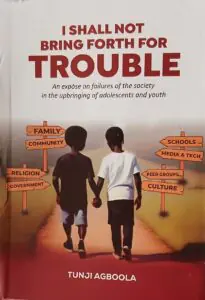
The book is titled I Shall Not Bring Forth for Trouble: An Exposé on Failures of the Society in the Upbringing of Adolescents and Youth. It is written by Pastor Tunji Agboola and published in 2023 by Black Jewels Network, Ibadan.
The author predicates the book on promise and hope, as indicated in the biblical truth of Isaiah 65:23 – “They shall not labour in vain, or bear children for calamity; for they shall be offspring blessed by the Lord – and their descendants as well.”
There are 13 chapters in this 246-page book. And all the chapters, while they are each organic in essence, dovetail into one another in an exhaustive exploration of adolescence within the crossfire of agents of socialisation.
The crux of the matter however, is that, with the pervasive and ubiquitous nature of all these agents of socialisation, young people of today face unprecedented challenges. They are bugged down by mental health issues, substance abuse, identity crises, and educational inequalities.
It follows, therefore, to submit that the agents of socialisation that ought to provide proper guidance, support and set agenda are failing, or have failed. Consequently, the book is written to provide a compass for all levels of society’s elements.
Essentially, I Shall not Bring Forth for Trouble is unpretentious. It acknowledges the issues, provides a detailed appreciation of the agents of socialisation and their roles, and highlights consequences and case studies. The book also offers practical solutions, appeals to the sense of the collective and empowers with knowledge that will provoke action.
In a nutshell, the author states categorically (p2) that the book is to “prevent and control social vices, drug abuse, and other anti-social behaviours among young people by providing understanding to society, that is the so-called agents of socialization….”
And the first chapter of the book swiftly sets the mood. It explores some of the fundamental issues, misunderstanding and misplaced perceptions that society faces in the adolescent phase of the children.
The author is not uninformed in the nitty-gritty of his subject matter. He falls back on his almost three decades of youth development, drug prevention, treatment and care, drug addiction and rehabilitation services as an activist, advocate and champion with his Goodworker Ministry International, a non-governmental organisation.
So his criticism, pronouncement, analyses, postulations and prescriptions are backed by his years of cognate experience and empirical data in the field dealing with young people in Nigeria.
Because the adolescent years of children are filled with huge bouts of challenges and lack of direction, they are exposed to high level peer pressure and influence, confusion about identity and self definition, any mistake in managing this period poses potential risks to their body and mind.
This heaps on them both long- and short-term consequences which can be ghastly. They may include risky behaviours, self-harm, sexual risk-taking, substance abuse, tolerance, dependence and addiction, “Yahoo Yahoo” among many others.
On the flip side, the author argues for the youth and adolescent population of Nigeria in this work. He avers that when properly harnessed, the energy of young people can be harvested for productive things.
He insists that their keen sense of awareness, access to global technological innovations and their adaptability can make them become assets useful for their own good and betterment of society, when the agents of socialisation are alive and responsive.
All these, complemented with a list of innovations contributed by adolescents across the world are showcased in the work. These are highlighted in the second and third chapters of the book.
In this book, Pastor Tunji Agboola adopts a multidisciplinary approach to his exposé on socialisation. He digs into literature on his subject matter with a measure of dexterity and plucks out for the reader, rich material for information and education.
Thus in the fourth chapter, he highlights the agents of socialisation, pinpointing their specifics. He spends time too, to expatiate the concept of socialisation and its processes.
However, the author is not satisfied with just a snapshot presentation of the different agents of socialisation. He identifies them as the family, the school/education, community and peer groups. Others include culture, media and technology, religion and government.
He then follows with deeper dives into these agents, drawing out their pitfalls, potency and making clarifications about how they can be harnessed productively in the succeeding chapters, starting with the family in the fifth chapter.
According to the author, the family is the most essential primary agent of socialisation. The family lays the foundation for the individual’s interactions, beliefs, values and behaviours for all of life. And it exerts profound and lasting impact on the development of the adolescent.
Indeed, what a person turns out to be in the larger society is first imbibed at the family level. In the author’s estimation (p71) “the family’s early and continuous influence remains significant in shaping an individual’s social identity and integration within society.”
This is followed with an extensive discourse on the roles of the family, parenting and parenting styles and the author’s prescriptions.
The foundation is laid by the family, and the school follows up, reinforcing the ideals, especially when we consider the time children and adolescents spend in the school.
This is the preoccupation of the author in the sixth chapter, while the next chapter dives into the community which “is the tapestry upon which young individuals weave the fabric of their lives, providing opportunities for connection, growth, and meaningful engagement with the world around them.” (P94)
The peer group is made up of friends and acquaintances with similar age and interests. It is the platform for adolescents to learn and explore social norms, identities, social skills and emotional intelligence. But the author argues (p108) that the influence of peer groups, while significant, “is not always straightforward or without challenges.”
This is a critical pressure point punctuated by landmines as focus is shifted from parents towards peers. Navigating this stage positively is therefore crucial for the adolescent. So the nature, risk and challenges, and how to make the best of this critical agent of socialisation is explained exhaustively in the eight chapter.
The next chapter follows with the equally undeniable importance of culture, a critical agent which shapes worldview and influences choices and character of adolescents.
Today, the world has shrunken into a web of interconnected invisible networks. And the adolescents of this age are caught right in the middle of the “promise and peril” of media and technology.
It is within the scope of media and technology that the digital fabrics of the lives of adolescents are “woven strand by strand.” And it is the preoccupation of the author to bring to the notice of young ones, adolescents and the entire society, the appreciation of media and technology, as well as his cautionary note.
Yes, the media offer youths entertainment and leisure, education and information, models and means of self-expression, yet there are impacts and implications.
So, the author strongly advocates strong media literacy and caution as adolescents navigate that infinite system. The author’s legal, moral and spiritual exhortation are pleadingly placed in chapter ten of the book.
The book’s next two chapters break down the essence of religion and government as agents of socialisation for adolescents.
In the 13th and last chapter, the author makes a case for an integration of all agents of socialisation. In that chapter, he makes general and specific recommendations about how to harness the agents of socialisation, including cluster approaches, and explains the ways to achieve that.
He concludes by highlighting the benefits of aggregating the agents of socialisation, drawing case studies from around the world to make his case.
The book concludes with a collection of write ups by distinguished members of the civil society on the author’s subject matter.
The author’s ultimate message summarised (p167) in this work is this: adolescents should not be left in limbo. Their journey “should not be one of trouble but one of blessings and promise.”
And the task of making it productive is to be shared by all to create the environment that will make the adolescent years of children what we will all be proud of.
Indeed, I Shall not Bring Forth for Trouble is a text, an exposé, and a call to action. It is a well-written, well-researched work for all segments of society.
•Olatunbosun is a broadcast journalist, book reviewer, and trainer.