



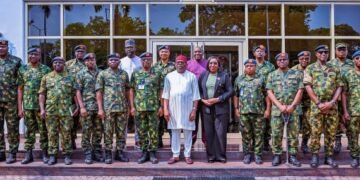











“The struggle against terrorism has now endured for more than a decade in Nigeria. The events following the Christmas Day airstrikes have once again revealed the adaptability and persistence of militant networks operating within the country’s borders.”
The escalation of terrorist violence across Nigeria since the precision airstrikes executed on 25 December 2025 has assumed a profoundly alarming character, revealing both the adaptive resilience of militant networks and the structural fragilities within the nation’s security apparatus.
What was publicly presented as a decisive intervention against entrenched jihadist elements has, in the months that followed, coincided with a marked intensification of insurgent and bandit activity across several geopolitical zones.
Rather than producing a sustainable degradation of terrorist or Fulani jihadist capacity, the aftermath of the strikes appears to have catalysed a wave of retaliatory violence, dispersal, and operational reorganisation among militant factions whose activities now span the North-East, North-West, and North-Central regions, with faint but worrying signals emerging further south.

On Christmas Day 2025, United States forces, acting in operational coordination with Nigerian security authorities, executed targeted aerial strikes against camps linked to the Islamic State within Sokoto State in the north-western corridor.
The operation reportedly involved precision-guided munitions and aerial reconnaissance platforms directed at terrorist encampments in the Tangaza axis, an area believed to harbour elements of the Lakurawa network, itself widely understood to maintain operational linkages with jihadist structures across the Sahel.
President Donald Trump publicly characterised the operation as a necessary intervention against extremist formations accused of perpetrating systematic violence against Christian communities in Northern Nigeria. The operation was described as a powerful strike against terrorist formations and was received by Nigerian authorities as evidence of growing strategic cooperation in the fight against transnational extremism.
Yet, the subsequent trajectory of violence demonstrates that tactical success has not translated into decisive strategic advantage. Surviving militants rapidly dispersed from their original encampments, reorganised operational structures, and initiated retaliatory attacks across a broad swathe of Nigerian territory.
Between late December 2025 and early March 2026, credible reporting documented a sharp rise in killings, mass abductions, village raids, and direct assaults on military installations. The pattern of violence reveals not merely episodic instability but the manifestation of a deeply entrenched insurgent ecosystem capable of absorbing shocks and adapting with alarming speed.
In the North-East, historically the epicentre of jihadist insurgency associated with Boko Haram and the Islamic State West Africa Province (ISWAP), militant activity during the opening months of 2026 displayed renewed intensity and sophistication.
Armed groups increasingly demonstrated the capacity to integrate modern tactical innovations into their operations. Reports indicate that terrorists have begun utilising unmanned aerial devices for reconnaissance and in certain instances, offensive deployment. Such adaptations signal an insurgency that continues to evolve technologically despite years of sustained military pressure.
Between January and February 2026, several forward military positions in Borno State came under coordinated attack. One particularly grave engagement occurred in Malam Fatori, where jihadist fighters overran a military outpost and reportedly killed approximately twenty Nigerian soldiers.
Subsequent clashes across the Konduga, Marte, Jakana, and Mainok corridors produced additional fatalities among both military personnel and civilians. These confrontations frequently involved prolonged firefights, the deployment of improvised explosive devices, and the destruction of military equipment.
The persistence of such operations demonstrates that insurgent logistics, recruitment networks, and territorial mobility remain far from extinguished. Civilian communities in rural districts continue to bear the gravest consequences of this violence. Abductions, targeted killings, and forced displacement have persisted unabated, intensifying the humanitarian pressures already confronting populations exhausted by more than a decade of insurgency. Entire villages have been depopulated as residents flee the relentless threat of armed incursions.
The North-West has experienced particularly immediate repercussions following the Sokoto strikes. Dispersed fighters from the targeted camps appear to have merged with pre-existing bandit formations operating within the forested belts of the region. The fusion of jihadist ideology with organised criminal enterprise has produced a hybrid security threat characterised by both ideological militancy and profit-driven violence.
States such as Zamfara, Katsina, Kebbi, and Kaduna witnessed a proliferation of kidnappings and targeted killings during the early months of 2026. In January alone, coordinated attacks across Katsina and Zamfara resulted in at least eleven deaths and more than 50 abductions. February brought further escalation. Raids across rural communities in Zamfara produced dozens of civilian fatalities, while militants believed to be affiliated with Lakurawa reportedly killed, at least, 34 residents in Arewa Dandi on 18 February 2026.
In Kajuru, the abduction of church congregants during a religious gathering illustrated the calculated exploitation of vulnerable communities for ransom operations. Such incidents demonstrate how ideological militancy increasingly intersects with lucrative criminal activity, creating an ecosystem of violence sustained by both extremist conviction and financial incentive.
More disturbing still has been the expansion of militant activity into the North-Central region, a geographical corridor long regarded as a strategic buffer separating northern insurgency zones from southern Nigeria. States including Kwara, Niger, Benue, and Plateau have increasingly experienced incursions by heavily armed groups seeking to establish new operational footholds.
Militant groups appear to be exploiting poorly governed territories surrounding Kainji National Park, whose dense terrain offers natural concealment and strategic mobility. The most devastating single episode occurred between 3 and 4 February 2026 in Kaiama, where attackers assaulted the villages of Woro and Nuku.
Reports indicate that victims were bound before execution, homes were set ablaze, and dozens of residents abducted. The death toll was estimated at between 162 and more than 200 individuals, making it one of the most lethal massacres recorded in Nigeria in recent years outside the long-standing North-East insurgency theatre.
Further attacks in Niger State during February 2026 resulted in at least seventy-one deaths across separate incidents on 14 and 28 February, with additional kidnappings compounding the tragedy. The expansion of militant activity into these territories signals a strategic shift that carries grave implications for Nigeria’s national stability.
In contrast, the South-West has experienced relatively limited direct terrorist violence during this period, although isolated abductions and the gradual migration of armed groups toward border zones suggest that complacency would be dangerously misplaced. The slow southward creep of militant influence raises the possibility that regions previously insulated from insurgency may eventually confront the same destabilising pressures that have plagued Northern Nigeria for years.
Amid these grim developments, a troubling strand of policy discourse continues to advocate so-called “non-kinetic” approaches as the primary solution to Nigeria’s security crisis. Such arguments, often framed in the language of reconciliation and socio-economic reform, betray a profound misunderstanding of the adversary confronting the Nigerian state.
Terrorist organisations driven by ideological extremism and sustained by the lucrative economics of kidnapping and extortion are not pacified by dialogue, nor persuaded by sentimental appeals to communal harmony. To suggest that murderous networks responsible for mass killings and village destruction can be persuaded into peaceful coexistence through negotiation is not merely naïve; it is a dangerous illusion that risks emboldening the very forces it seeks to appease.
History has repeatedly demonstrated that such groups exploit negotiations not as pathways to peace but as opportunities to regroup, rearm, and expand their operations. Ceasefires have too often been treated by militants as tactical pauses rather than genuine commitments to peace. Persistent advocacy of non-kinetic strategies as a primary instrument of policy represents a fundamental misreading of both empirical evidence and strategic reality.
Responsibility for Nigeria’s national security coordination rests principally with the office of Nuhu Ribadu, the National Security Adviser (NSA), who has now occupied that position for approximately three years. During this period, Nigerians expected a coherent and effective national security doctrine capable of reversing the deteriorating trajectory of insurgent violence.
Yet, the record thus far reveals no tangible strategic breakthrough. Terrorist networks continue to expand their geographic reach, kidnapping has become a widespread criminal economy, and military formations remain vulnerable to repeated attacks. The figures themselves speak with brutal clarity: the massacre in Kwara alone claimed between 162 and more than 200 lives; seventy-one additional fatalities were recorded in Niger State raids during February 2026. Soldiers have been killed in successive attacks on military positions in Borno, while dozens of civilians across the North-West have perished in raids and kidnappings.
Three years constitute a considerable period within which a national security framework ought reasonably to produce measurable outcomes. When such outcomes fail to materialise, responsible governance demands sober reassessment. National security is not an arena in which policy inertia can be tolerated indefinitely; it is a domain in which failure carries the gravest human consequences.
It therefore becomes increasingly difficult to avoid the conclusion that Nigeria’s present security leadership requires renewal. The replacement of the NSA would not constitute an act of political vindictiveness but rather a necessary recalibration within the machinery of state. Effective counter-terrorism demands leadership capable of integrating intelligence, coordinating military operations, and sustaining decisive strategic momentum. Where such momentum is absent, institutional change becomes both legitimate and necessary.
Nigeria’s struggle against terrorism has now endured for more than a decade. The events following the Christmas Day airstrikes have once again revealed the adaptability and persistence of militant networks operating within the country’s borders. The continued reliance upon hesitant strategies and misplaced faith in negotiation risks prolonging a conflict whose victims are overwhelmingly ordinary citizens.
The path forward requires strategic clarity. Terrorist sanctuaries must be dismantled through sustained military pressure. Intelligence coordination must be strengthened, aerial surveillance expanded, and international partnerships deepened where necessary to close capability gaps. Above all, Nigeria’s security leadership must reflect an unwavering commitment to decisive action, rather than rhetorical reassurance.
The stakes could scarcely be higher. If the present trajectory continues unchecked, the country risks witnessing the further entrenchment of violent networks capable of destabilising ever larger portions of its territory. Nigeria cannot afford the luxury of strategic ambiguity. The defence of the state demands firmness of purpose, clarity of doctrine and leadership willing to confront harsh realities rather than evade them.
•Aduwo is the Permanent Representative of the Center for Convention on Democratic Integrity (CCDI) to the ECOSOC/United Nations.