







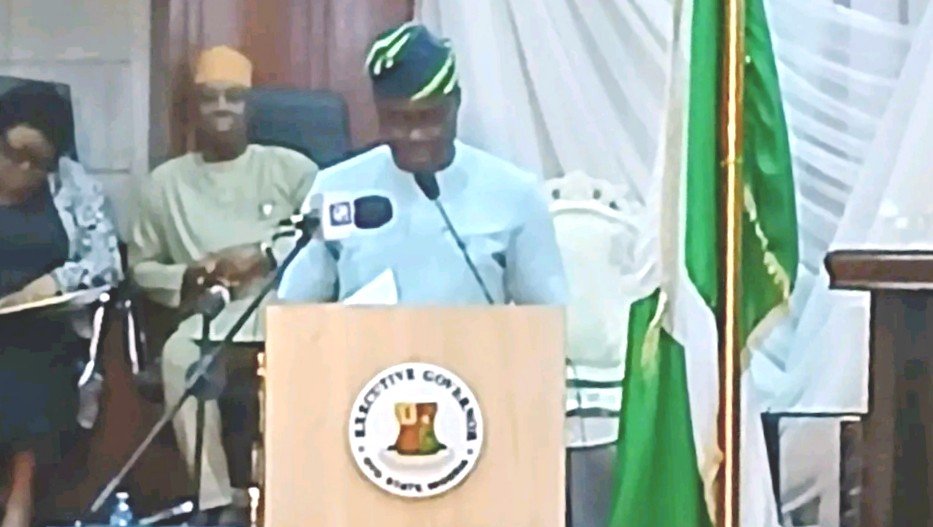
Oyo State governor, ‘Seyi Makinde, on Tuesday, presented a proposed ₦1.115 trillion 2027 Appropriation Bill before the state House of Assembly, marking the last budget presentation by his administration.
Makinde and his 2027 Appropriation Bill
PHOTO: Oyo Gov’s Media Unit.
The 2027 budget proposal marked the final budget of the two-term administration of the governor, ending on 29 May, 2027.
The budget, tagged “Budget of Sustained Progress,” was presented on Tuesday at the Assembly complex in Ibadan.
The proposed ₦1.115 trillion budget represented a substantial increase over the ₦891.99 billion proposed for the 2026 fiscal year.
The 2026 proposal, tagged “Budget of Economic Expansion,” included ₦502.65 billion for capital expenditure and N389.34 billion for recurrent expenditure.
Infrastructure received the largest sectoral allocation of ₦210.02 billion, followed by education with ₦155.21 billion, health with ₦70.81 billion and agriculture with ₦19.99 billion.
The previous budget also reflected the administration’s emphasis on infrastructure development, human capital investment and economic expansion.
With the proposed 2027 budget rising to ₦1.115 trillion, focus will be on how the government intended to sustain these priorities, while addressing emerging economic and developmental needs across the state.
For residents, the major concern will be whether the proposed expenditure translates into tangible improvements in infrastructure, education, healthcare, agriculture, security and economic opportunities.
The budget will also provide an opportunity to address outstanding development needs across the state’s 33 local government areas, particularly in rural communities where access to quality roads, healthcare facilities, schools and other essential services remained important.
Expectedly, infrastructure development would remain a major issue, considering the administration’s previous investments in road construction, rehabilitation and other public infrastructure.
Similarly, allocations to education and healthcare will attract attention as residents assess the government’s commitment to improving public institutions and ensuring that development reaches different parts of the state.
The agricultural sector will also be important in determining how the government intends to strengthen food production, support farmers, improve agricultural value chains and contribute to food security.
Following the presentation, the proposed appropriation bill will be subjected to legislative scrutiny by the Oyo State House of Assembly.
The lawmakers were expected to examine the estimates, review the proposed expenditure and engage relevant ministries, departments and agencies during the budget defence process.
The exercise will provide an opportunity for the state legislature to question government officials on proposed projects, revenue expectations, implementation strategies and the financial implications of the various programmes contained in the estimates.
The legislature also has the responsibility of ensuring that public funds were appropriated in line with the developmental needs of the state and that the proposed expenditure reflected the interests of residents.
While the lawmakers may make adjustments to the estimates before passing the bill, the governor will subsequently be required to assent to the Bill before becoming the 2027 Appropriation Law.
The presentation marked a significant moment in the governor’s administration, which began in May 2019 and was expected to conclude after eight years in office.
The proposed fiscal document would set out the government’s spending priorities, revenue projections and development programmes for the 2027 financial year.
It will also provide an opportunity for the administration to consolidate projects and policies introduced during its two terms.
Makinde had earlier communicated his intention to present the budget in a letter addressed to the Speaker of the House, Adebo Ogundoyin, which was read to lawmakers during plenary.
In the communication, the governor explained that the presentation was in compliance with Section 121(1) of the 1999 Constitution of Nigeria, as amended, which required state governors to lay annual appropriation estimates before their respective Houses of Assembly.
He described the proposed 2027 budget as particularly significant because it would be the final budget cycle of his administration.
This, he described as providing an opportunity to consolidate the gains of governance and sustain the developmental achievements recorded since he assumed office.
The governor’s appearance before the lawmakers also came against the backdrop of recent political developments in the state, particularly the resignation of some political appointees and government officials ahead of the 2027 general election.
During his address, Makinde reacted to the wave of resignations, saying the departures of the affected officials did not have any significant meaning to him and would not derail the work of his administration.
He acknowledged that some members of his government had resigned but maintained that their decisions would not affect the delivery of governance in the state.
The governor also disclosed that a female official among those who left his administration had approached him with what he described as an impossible request.
He further disclosed that female appointee subsequently resigned after he declined the request.
Although he did not identify the official or disclose the nature of the request, his comments added a political dimension to the budget proposal presentation, coming at a time when political activities were gathering momentum ahead of the 2027 elections.
Among the notable departures from the administration is that of former Chief of Staff, Otunba Segun Ogunwuyi, alongside other former officials.
Their resignations have generated political discussions about the future of the administration and possible realignments ahead of the next electoral cycle.
The process was particularly significant because the budget will be implemented during an election year, when political activities and preparations for the transition to a new administration are expected to intensify.
For Makinde, the proposed 2027 budget represented the final major fiscal blueprint through which his administration can pursue its development agenda before handing over power in 2027.
Having served two terms since 2019, the governor was constitutionally ineligible to seek another consecutive term in office.
The final budget therefore presented an opportunity to consolidate ongoing projects, complete priority infrastructure and establish sustainable programmes that can continue beyond his administration.
It will also provide a basis for assessing the extent to which the government has fulfilled its development commitments since assuming office.
Beyond the size of the proposed expenditure, the effectiveness of the budget will ultimately depend on revenue performance, timely releases, prudent management of public resources and the actual execution of approved projects.
The ability of the administration to ensure that projects captured in the appropriation are completed before the end of its tenure will also be an important measure of its performance.
With the formal presentation now completed, attention shifts to the Oyo State House of Assembly, where lawmakers were expected to commence consideration of the ₦1.115 trillion proposal.
The outcome of the legislative process and the eventual implementation of the budget will determine how effectively Makinde’s administration uses its final year to sustain its development agenda and prepare the ground for the next government.