










Ahead of the 2027 general election, the International Press Centre (IPC) has urged journalists to move beyond routine campaign coverage and embrace issue-based reporting, fact-checking, and democratic accountability.
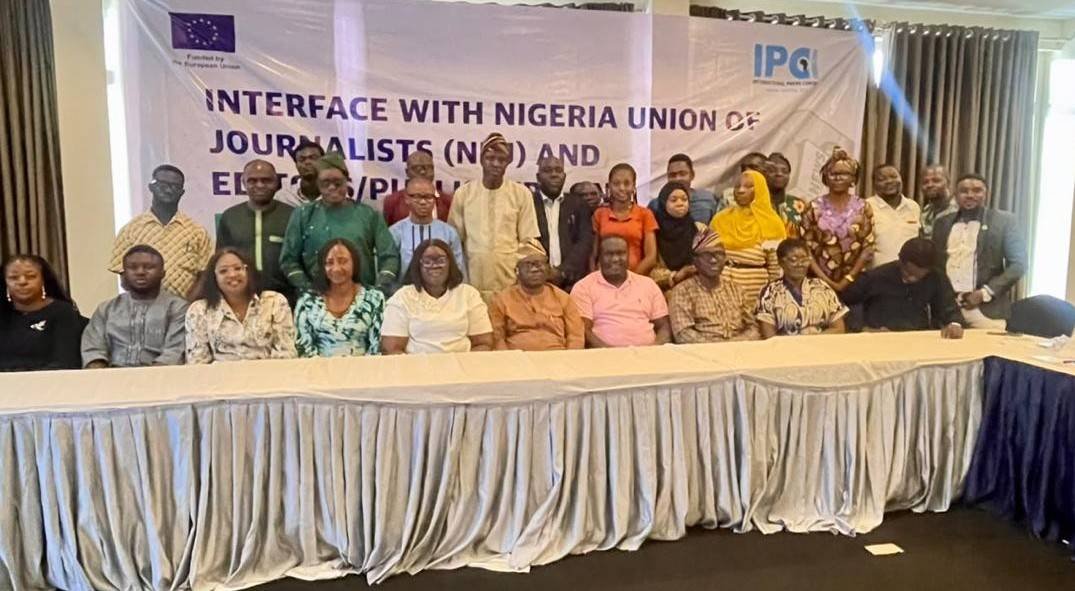
The centre made the call, on Tuesday, during an interface with the Nigerian Union of Journalists (NUJ), Oyo State Council and Editors/Publishers on Professional and Democratic Accountability Journalism ahead of the 2027 General Election.
2027 General Election and the IPC interface with journalists
The interface was organised IPC, under Component 4 (Support to Media) of the European Union Support to Democratic Governance in Nigeria (EU-SDGNIII) Programme.
The essence of the media training was to strengthen journalists’ capacity for credible, balanced and citizen-centred electoral reporting.
Emphasis was laid on the need for journalists to document political manifestos and campaign promises, scrutinise government policies and track the implementation of electoral commitments to ensure that public office holders are held accountable.
Speaking, IPC Executive Director, Mr Lanre Arogundade, said elections should not be viewed merely as political campaigns, rallies, candidates and the announcement of results, but as opportunities for citizens to make informed decisions about their future.
According to him, electoral reporting should give adequate attention to critical issues affecting Nigerians, including the economy, education, healthcare, security, employment and infrastructure.
He added that the role of the media during elections also included ensuring that women, young people, persons with disabilities and other under-represented groups have a voice in the democratic discourse.
He therefore called on journalists to prioritise accuracy, fairness, verification and conflict-sensitive reporting in the build-up to the 2027 elections.
Also speaking, NUJ chairman, Oyo State Council, Comrade Akeem Abas, stressed that journalists have a significant role to play if Nigeria was to achieve meaningful progress.
He urged media practitioners to go beyond reporting political campaigns and rallies by monitoring the fulfilment of promises made by candidates and elected officials.
The training featured two different training sessions, with the first one by Olusola Oludiran being on “Integrating Fact-Checking For Democratic And Accountability Reporting.”
The second session, on “2027 General Election In The Context Of Democratic And Accountability Reporting: Scanning the Electoral Environment and Reporting Citizens’ Priority Concerns,” was facilitated by Taiwo Adisa, PhD.
In the first session, Oludiran introduced participants to basic fact-checking tools and techniques.
He described democratic accountability reporting as the practice of gathering, verifying, interpreting and disseminating accurate, relevant and diverse information.
This, he said, was to enable the citizens to understand public affairs, participate meaningfully in democratic processes and make informed decisions.
Olusola explained that the media, as the fourth estate of the realm, has a responsibility to inform citizens about elections, public policies, government decisions, human rights and issues affecting their communities.
According to him, the responsibility of journalists goes beyond reporting events but also verifying claims and providing credible evidence to support their findings.
He described fact-checking as an essential aspect of journalism that required rigorous investigation and technical expertise, particularly in examining images, videos and other digital content frequently used to spread misinformation and disinformation.
The session also examined the growing threat of election-related disinformation in the era of artificial intelligence.
The participants learned how Generative AI can make it faster, cheaper and easier to produce convincing fake text, images, audio and videos capable of misleading voters.
Oludiran stressed the importance of fact-checking in curbing misinformation, improving the quality of information in the public space and building trust between the media and citizens.
He encouraged journalists to adopt the principle, adding: “Assume nothing, believe nothing, check everything,” as a guide to professional reporting and information verification.
The second session, facilitated by Taiwo Adisa, PhD, focused on the need for journalists to examine the electoral environment, identify issues affecting citizens and ensure that public interest concerns receive adequate attention in political reporting.
While describing the media as a bridge between the government and the people, he noted that journalists must ask critical questions about public policies, governance decisions and issues affecting the welfare of citizens.
The former Oyo State Governor media aide highlighted the importance of holding government accountable while maintaining professional accountability in journalism practice.
He also emphasised the importance of factual accuracy in journalism, stressing that media practitioners must distinguish between opinions and verifiable facts while reporting political developments.
“Comments are free; facts are sacred in journalism,” Dr Adisa declared.
Participants were encouraged to examine key issues affecting their communities and ensure that citizens’ priorities and concerns shape electoral discourse, rather than allowing campaign activities and political personalities to dominate coverage.
The session further underscored the media’s responsibility to contribute constructively to governance by providing feedback and drawing the attention of public officials to the needs and expectations of the people, without compromising journalistic independence.
As preparations for the 2027 general election gather momentum, the training highlighted the need for journalists to play an active role in strengthening democratic processes through credible reporting, rigorous verification and sustained monitoring of government performance.
The engagement reinforced the position that responsible electoral journalism should not end with the announcement of election results but should also continue through the monitoring of campaign promises, public policies and the delivery of dividends of democracy to citizens.