
















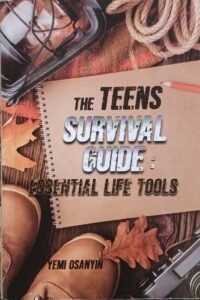
The Teens Survival Guide: Essential Life Tools (2026, Shekinahouse) was written to serve as a guidebook for adolescents and empower them with life management skills. The book was written by Yemi Osanyin.
The Teens Survival Guide, A Review
 Mr Osanyin is an Organisational Effectiveness Specialist with over 30 years of social development work.
A University of Ibadan graduate in History and Political Science, he has had stints with the Federal Ministry of Health, and led major adolescent reproductive health projects for the Association for Reproductive and Family Health (ARFH), the Planned Parenthood Association of Liberia (PPAL), and the Management Strategies for Africa (MSA).

This book is predicated on the fact that young people face multi-dimensional challenges and are under immense pressure as they navigate life.
The author’s conviction is based on the fact that the adolescent phase is full of landmines that can overwhelm them, thus exposing these landmines and teaching adolescents how to withstand the storms of life is important.
There are 22 chapters in this book. And the author arranges the chapters from the simple to the complex intricately holding the hands of his primary audience as he guides them through the maze of life.
The book is based on themes of self-discovery, self-awareness, management and survival. On the basis of that, the author begins the book by providing the most basic life skill upon which all others fall.
The first seven chapters deal with the theme of personal development, which is a call to look inwards. It all begins with self-awareness, which the author describes (p3) as what makes someone identify who he or she is; or how people “perceive and understand the things that make them who they are as individuals, including personality, actions, values, beliefs, emotions and thoughts.”
Using his storytelling prowess to full effect, the author then leads adolescents into how self-awareness is cultivated.
Of course, a proper identification of the self will potently aid values definition, which also gives clarity to how a person carries himself and crafts a sense of direction. A clear sense of direction in turn aids the cultivation of mental and emotional health, leading to a positive self-esteem.
A healthy self definition and self-esteem exercise will ensure that the adolescent develops a large dose of emotional intelligence, self-control and the ability to know his or her triggers.
In the book, The Teens Survival Guide, the second sub-division consists of five chapters around the theme relationship and social skills.This arrangement is strategic: healthy self-definition and value clarification help in cultivating healthy interpersonal and social relationships.
In the light of this, the author highlights the crucial roles and benefits of interpersonal skills for adolescents, especially in a world that is fast-paced, with many young ones struggling with how to handle one-on-one communication.
This is followed by expositions on how to be assertive, especially in a phase of life filled with bullies. In addition, the author inputs in the book a very important element: leadership skills for adolescents.
Of course, it is easy for society to delay exposing them to the rudiments of leadership till when they are considered ready. But when will they be ready if not now?
So the 10th chapter has potent information on how young people can develop and improve their leadership skills, and the value that leadership skills can bring for them and the community at large.
The chapters in this book are clearly defined and structured. They are all both organic and complementary in an interconnected chain, graduating in a thematic sequence of the sections. That is why it is a smooth read for me.
Thus, the third section has five different topics grouped under the broad theme of life management. If one successfully masters the self, and uses that to define relationships, successfully navigates social and interpersonal engagements like conflicts and dating, then most of what lies ahead is surmountable.
In other words, if you are able to set your life’s goals, you’ll be able to stay focused even in the moment of despair. That is why the author asserts (p72) that goal setting is the one skill that helps young people to keep their eyes on the destination, avoid errors, drive their life endeavour and succeed.
He follows with tips on how to set goals and priorities, which are in turn essential to how one allots time to specific activities, and consequently increase effectiveness, efficiency and productivity (p85).
Today, young people operate within the crossfire of technological innovations which however constitute potential distractions as they navigate life. Many of them struggle with studying because they get easily distracted, and this may negatively affect their performance in class and during examinations.
The author has a way out in the 17th chapter of the book, The Teens Survival Guide. Tagged Effective Studying Skills, the author explains the rudiments of reading and studying, how to get the best out of studying periods for ultimate success.
The fourth section of the book covers protection and safety matters, and it includes five chapters. Here the author teaches that risks lurk around, and adolescents will do well to be able to know them and stay safe. So we have tips on how to cultivate self-defence skills, especially for girls, and how to assertively make safe decisions even under pressure.
This section on self-defence (chapter 19) is important for all categories of readers. This is because being able to decline an unwanted request in a clear, assertive and respectful manner is a big problem.
Therefore to be able to do this, the author suggests behaviours that help refusal skills (p117) like knowing what you want and being certain about it, knowing that saying NO is possible, and being firm about it is possible, etcetra.
The rest of the book provides life-changing information on how to identify and deal with red flags, and sexual abstinence skills.
The book, The Teens Survival Guide: Essential Life Tools, is not a text like many written for adolescents; it is a workbook with practical insights, relatable stories and tips to help adolescents define themselves, gain personal and social clarity, engage with others assertively and become successful in all their endeavours in life.
The book is written with the benefit of the author’s many decades of practice and professional expertise working with young people.
Every one of the book’s 151 pages is loaded with potent survival tips useful for all categories of readers, and the author’s deployment of his storytelling prowess makes the book a compelling read.