















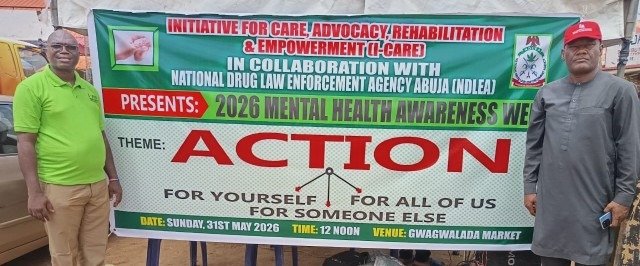
Initiative for Care, Advocacy Rehabilitation and Empowerment (I-CARE), a non-profit organisation, and the National Drug Law Enforcement Agency (NDLEA) have taken the campaign against drug abuse to traders and residents of Gwagwalada Market, Abuja.
The campaign, held on Sunday, was part of concerted efforts by the organisation at raising awareness about the dangers of hard drug abuse and illicit substance use.
Held with the theme, Action For Yourself, For All Of Us, For Someone Else, the event was part of the activities organised to mark the I-CARE 2026 Mental Health Awareness Week.

I-CARE, NDLEA And War Against Drug Abuse
I-CARE and NDLEA officials, during the outreach programme, enlightened traders and youths on the health and socio-economic implications of social vice.
The two organisations also emphasised that individuals and communities should stay away from illicit substances.
Public Relations Officer of I-CARE, Talubi Olusegun, said the essence of the sensitisation campaign was to educate the public, particularly traders and youths on effects of drug abuse.
He advised members of the public to prioritise their mental health and well-being, noting that drug abuse constituted a major threat to individuals, families and communities.
Olusegun further revealed that abuse of substances remained a contributory factor to mental health disorders, crime, violence and loss of productivity.
According to him, the theme of the 2026 Mental Health Awareness Week underscored the collective responsibility of individuals and the society in promoting healthy lifestyles and supporting those struggling with addiction and mental health challenges.
Olusegun urged participants to shun the use of illicit substances and seek professional help whenever they experience emotional or psychological difficulties.
This was as he called on community leaders, parents and market associations to join hands in creating awareness and supporting efforts aimed at preventing the social malaise among young people.
He reaffirmed the commitment of the organisation to advocacy, rehabilitation and empowerment programmes targeted at vulnerable groups.
He also assured that the organisation would continue to partner with relevant stakeholders to promote mental health awareness and build drug-free communities across the country.
Addressing the gathering, ndlea Assistant Director, Community Awareness, Directorate of Prevention and Sensitisation, Peter Njokwu, warned against abuse of hard drugs and the indiscriminate mixing of alcoholic beverages.
According to him, such an anti-social behaviour constituted serious and damaging risks to both mental health and physical wellness.
Njokwu further stated that many young people unknowingly endanger their lives by mixing and consuming different alcoholic drinks illicit substances.
According to him, such practices can and often lead to addiction, organ damage, mental health disorders and, in severe cases, sudden death.
Most alcohol-related emergencies, he said, were as a result of indiscriminate mixing of spirits, beer, wine and locally-brewed drinks, adding that such a trend was dangerous and avoidable.
He averred that substance abuse was a major factor militating against public health, contributing to road accidents, domestic violence, mental health disorders and reduced productivity.
The NDLEA official added that it has become a growing concern in many communities, affecting not only users, but also families and society at large.
He urged traders and residents of Gwagwalada to remain vigilant and support efforts to identify and discourage drug-related activities within their communities.
Njokwu, an Assistant Commander of Narcotics at the anti-narcotic agency, urged parents and guardians to pay closer attention to their children and wards.
Warning that peer pressure, curiosity and lack of proper guidance often push young people into substance abuse, he stressed the need for continuous education and awareness campaigns to curb the tide of the social vice across the country.
He said NDLEA would continue to collaborate with organisations such as I-CARE, community groups and other stakeholders to promote a drug-free society, adding that prevention remained the most effective strategy in the war against drug abuse.
Participants commended the two organisations for the sensitisation campaign, describing it as timely and impactful.
They pledged to spread the message to their families, colleagues and neighbours, and also support efforts to combat substance abuse and promote mental well-being in their various communities.