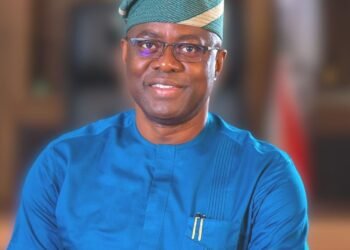














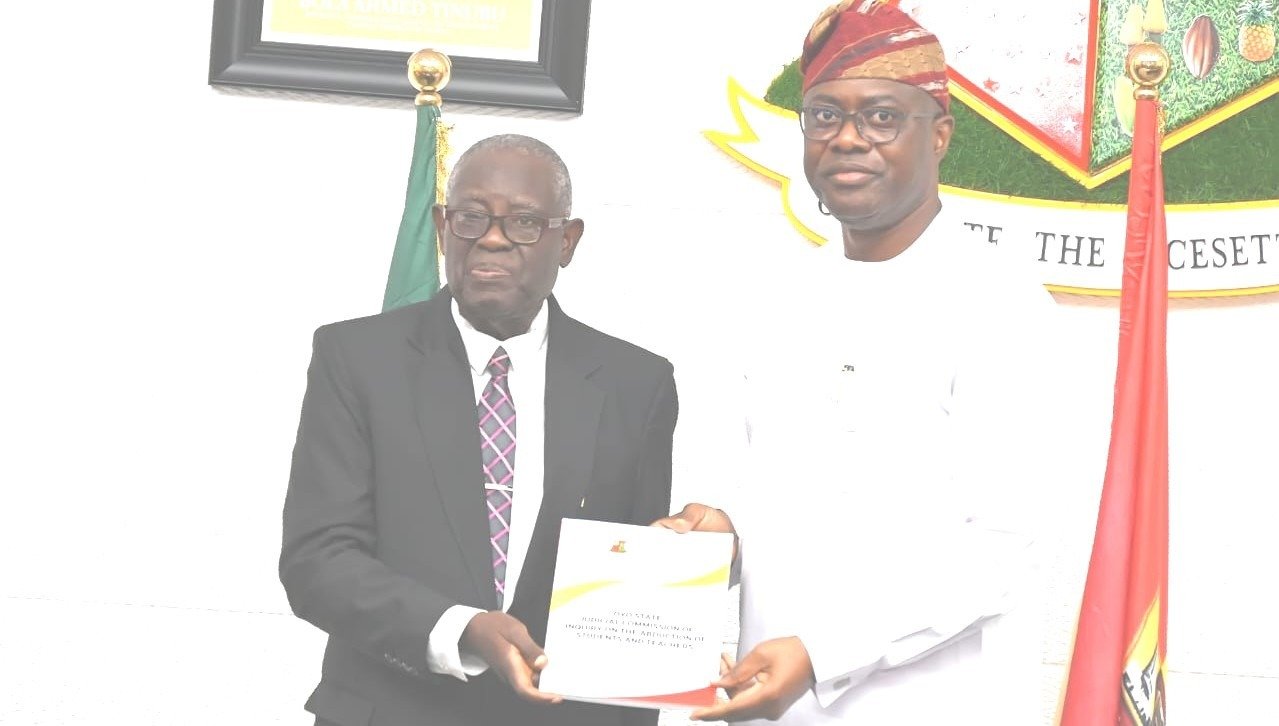
Oyo State governor, ‘Seyi Makinde, on Tuesday, received the inquiry report on the Oriire abduction, assuring of his commitment to executing a policy action on the report.
He assured the public that his administration will thoroughly examine the recommendations of the Judicial Commission of Inquiry set up to investigate the abduction of pupils and teachers at Oriire Local Government Area.
Oriire abduction, inquiry report and Makinde’s commitment to policy action
He emphasised that confidentiality will not be used as an excuse to avoid accountability.

Makinde gave the assurance while receiving the report from its chairman, Justice (Professor) Mojeed Owoade (rtd), at the Governor’s Office, Secretariat, Agodi, Ibadan.
The governor noted that the Oriire abduction tested the security architecture his administration had built over the years.
He said: “When we came into office, the 615 toll free number had been approved but was not yet operational.
“The City Watch and Security Control Room infrastructure had also been initiated, although parts of the system were not functioning as they should.
“We operationalized the 615, refurbished and expanded the control room, expanded its coverage, and connected the Police, Amotekun, Operation Burst, and other relevant services through a communication system that helped them coordinate a response.
“Some people will say that under this administration, we brought down the crime rate. But Oriire is part of the record.
“No responsible government can point to earlier progress and ask families to overlook a grave failure of protection.”
Makinde praised those involved in the rescue operation, saying: “We can never diminish the effort of those who contributed — the Operational Coordination Centre, Amotekun personnel, hunters, vigilantes, the military, police, intelligence services, and other federal agencies.
“I must also thank the DG DSS and the State Directors of Security in Oyo and Lagos States who relocated to Oyo during this period.”
He emphasised that rescue alone is not enough, adding: “Rescue cannot be the only measure of success.
“We must ask: What could have prevented the attack? What could have shortened the ordeal? What will make children safer in their schools?”
Linking the lessons to his national advocacy, Makinde said: “This is why, at the national level, I have discussed a security reset for Nigeria.
“We must have distinct systems. The reason we could ask the commission to see where there may have been failure is because we have a system — so we can point to where it broke. Nigeria must also have a working system.”
He declared: “This commission’s report will lead to decisions, assigning responsibilities, and progress that the public can follow. Our children’s safety must be the test of what changes.”
Explaining the essence of the Judicial Commission, he said: “We established this Judicial Commission of Inquiry to examine how the attack occurred, what information was available, how institutions responded, whether there were intelligence, administrative, or operational failures, and what must change to prevent another such tragedy.”
The governor expressed deep appreciation to the Commission, saying “Let me specially, from the bottom of my heart, thank the chairperson and members of the commission for undertaking this difficult assignment.
“When it was set up, it was in a politically charged atmosphere. But you took on the assignment and saw it through to a logical conclusion. I say thank you on behalf of myself, the government, and the people of Oyo State.”
Presenting the report, Justice Owoade (rtd) thanked Governor Makinde for entrusting the Commission with the assignment.
He said: “We visited the scenes of the crime, inspected the affected schools, and went through the bushes to have first hand knowledge of what actually happened on that fateful day.
“We held public hearings in Ikoyi Ile, Ogbomoso, and Ibadan. On the whole, we took 72 witnesses, including victims, traditional rulers, civil society organisations, individuals, experts, and other stakeholders.
“We produced a report aimed at strengthening preventive security measures for the future through improved intelligence gathering and necessary cooperation between security agencies and government institutions.”
Justice Owoade explained that the Commission made recommendations for the Oyo State Government, local governments, joint Federal–State action, and the Federal Government.
The Commission’s chairman highlighted a major recommendation: “Of particular significance is our opinion that there is a need to review the laws and management of forest reserves, especially the Old Oyo National Park, which belongs to the federal government.
This is essential for maintaining security,” Justice Owoade added.