












The Guild of Corporate Online Publishers (GOCOP) has trained its members on the use of Artificial Intelligence (AI), prompt engineering and Search Engine Optimisation (SEO), while also urging online publishers to explore new revenue streams beyond advertising and sponsored content.
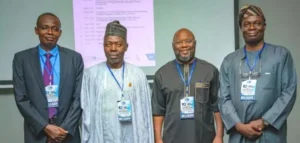
The Guild urged members to embrace AI and new revenue streams while protecting journalism, credibility and audience trust.
GOCOP Trains Members On AI, Prompt Engineering, SEO
The training formed part of activities marking the Guild’s 10th Annual Conference, which began on Wednesday, October 8, 2026, at the Radisson Blu Hotel, GRA, Ikeja, Lagos.
The two-day conference, which ends on October 9, has as its theme, “2027 Elections: Trust, Transparency and Shared Responsibilities.”
The sessions focused on helping Nigerian online publishers adapt to the rapidly changing digital media environment, where AI, declining search referrals, changing audience behaviour and pressure on advertising revenue are reshaping the journalism business.
AI Can Transform Online Newsrooms
AI expert and publisher of The Lagos Times, Sulaimon Durojaiye, who facilitated a session titled “The AI-Powered Newsroom: AI & Prompt Engineering for Online Publishing,” said publishers could deploy AI effectively without being programmers.
He explained that AI enables computers to perform tasks that ordinarily require human intelligence, including understanding language, recognising patterns, analysing information, generating content, solving problems, making predictions and assisting decision-making.
Durojaiye identified three major AI concepts publishers should understand: Generative AI, Large Language Models (LLMs) and AI-powered tools.
He explained that Generative AI could create and transform text, images, audio, video and code, while LLMs are systems trained on large volumes of information to understand and generate human language.
He cited ChatGPT, Gemini, Claude and Copilot among tools that publishers could explore as part of their digital newsroom operations.
However, he warned publishers against viewing AI as a replacement for journalism or search engines, stressing that information generated by AI could contain inaccuracies and must be independently verified.
According to him, while search engines generally locate information and provide links and sources for users to investigate, Generative AI can create, transform and analyse information.
Durojaiye Explains Power Of Prompt Engineering
Durojaiye also introduced participants to prompt engineering, describing it as the art and science of giving AI clear instructions to produce useful and relevant results.
He contrasted a vague instruction such as “write a story about the budget” with a detailed prompt that specifies the journalist’s role, task, context, requirements and expected output.
He identified the five-part AI prompt formula as Role, Task, Context, Requirements and Output, noting that the quality of instructions given to an AI tool would largely determine the quality of its response.
According to him, AI can assist journalists in news gathering and research by analysing lengthy speeches and reports, summarising government documents, extracting key facts, comparing documents, generating interview questions and identifying possible story angles.
He stressed, however, that AI cannot replace journalism or investigative reporting.
Rather, he said, the technology could assist throughout the publishing workflow, including interviews, transcription, writing, editing, SEO, social media, newsletters and analytics.
Durojaiye added that one news event could be developed into several content products with AI assistance, including news stories, features, explainers, profiles, interviews, opinion drafts, headlines, captions, newsletters and transformed press releases.
He emphasised that while AI could accelerate content production, journalists remained responsible for facts, context and editorial judgment.
AI Can Boost Search Visibility
Speaking on SEO, Durojaiye said AI could help publishers develop search-friendly headlines, SEO titles and meta descriptions, identify keywords and search intent, create frequently asked questions and content structures, suggest internal links and develop content clusters.
“The story isn’t finished when you publish it. It is finished when the right audience can find it,” he said.
His message underscored the growing importance of combining quality journalism with effective digital distribution, particularly as publishers compete for audiences across search engines, social media platforms, newsletters and emerging AI-driven information channels.
Publishers Must Look Beyond Advertising — Ashibogwu
In a separate session, Dr Monday Ashibogwu, Group Chief Executive Officer of Billsbox Services Limited and Publisher of Quick News Africa, urged online publishers to diversify their income sources as the traditional advertising model built largely around pageviews and clicks becomes increasingly vulnerable.
Presenting a paper titled “Monetisation of Digital Media Business: Earning Beyond Advertising and Sponsored Content,” Ashibogwu said audience behaviour had changed, with more people consuming information through platforms and increasingly using search and AI tools to obtain answers without necessarily visiting publishers’ websites.
He nevertheless said Nigerian online publishers possess an asset that advertising often undervalues — audience trust.
He challenged publishers to convert that trust into sustainable revenue.
Using global, African and Nigerian examples, Ashibogwu identified six non-advertising revenue streams: membership, events, training, data and intelligence, licensing, and products and services.
Falling Traffic Threatens Traditional Media Model
Ashibogwu said the media industry was facing a significant structural shift, pointing to audience migration and declining traffic from search.
He cited the Reuters Institute’s Digital News Report 2026, which surveyed nearly 100,000 people across 48 markets, and said analytics covering more than 2,500 news sites showed that referrals from Google search fell worldwide between November 2024 and November 2025.
He further warned that publishers expected a further 43 per cent decline within three years.
According to him, the challenge is straightforward: money follows the audience.
Therefore, an advertising model based primarily on pageviews becomes increasingly difficult to sustain when audiences are captured by social platforms or receive AI-generated summaries before reaching publishers’ websites.
Against the backdrop of warnings by the Nigerian Guild of Editors about a possible media collapse, Ashibogwu said Nigeria was already feeling the effects of the changing media economy.
Six Revenue Streams For Digital Publishers
He identified membership and reader revenue as one of the opportunities available to publishers, citing an international newspaper with 1.4 million members and earnings of more than £126 million in March 2026.
He also highlighted events and convening power, particularly with the 2027 elections approaching.
“The calendar is on our side. With the 2027 elections approaching, there is a ready demand for candidate debates, policy dialogues and town halls at state level,” he said.
Ashibogwu said credible online publishers could host such events, provided all participants were treated equally.
“A credible online publisher is well placed to host them, on one condition: every participant is charged on the same published terms, so that the platform is never for sale to one side,” he added.
Other opportunities, he said, included training and professional services; data, research and intelligence; licensing and collective bargaining; as well as products, services and commerce.
He urged publishers to recognise the value of years of beat coverage, saying their archives and accumulated information represented valuable data resources.
Publishers Urged To Own Their Audiences
Ashibogwu advised publishers to reduce their dependence on social media platforms and build direct relationships with their audiences.
“A follower on a platform is borrowed,” he said, citing The Continent, a Pan-African weekly, which built readership by delivering its newspaper directly through WhatsApp.
He urged publishers to start newsletters and WhatsApp channels while complying with the Nigeria Data Protection Act.
He also advised publishers to develop specialised niches.
“General news is a commodity. Readers and clients pay the publisher who knows one sector, one state or one community better than anyone else,” he said.
He advised publishers to begin with one revenue stream, test it for 90 days and measure the results rather than attempting to implement all six simultaneously.
He also warned publishers to protect editorial independence because revenue-generating relationships could create conflicts of interest.
“Our trust rating is the asset behind all six streams. If we spend it, we have nothing left to sell,” he said.
GOCOP Urged To Prepare For Content Licensing
On licensing and collective bargaining, Ashibogwu said other entities were using content created by Nigerian publishers to generate revenue.
He noted that following a joint petition by the Nigerian Press Organisation (NPO), of which GOCOP is a member, the President directed the Federal Competition and Consumer Protection Commission (FCCPC) to investigate how Meta, Alphabet, X and Generative AI companies use Nigerian news content.
“We should not wait for the outcome before we prepare,” he said, urging publishers to establish agreed data on traffic, archives and costs and develop a fair formula for sharing any benefits among GOCOP’s 127 members.
Ashibogwu said the next era of digital publishing would reward publishers for building relationships rather than merely counting visitors.
“The next era will reward those who count relationships: members, delegates, trainees, clients and licensees,” he said.
He cited industry forecasts from the Reuters Institute putting Nigeria’s media market at about $540 million by 2029, with roughly half expected to be digital.
He recommended that every publisher leave the conference with one new revenue stream and a 90-day test, while GOCOP should establish a standing committee on revenue and licensing.
“We have the trust of the audience. Let us now build the business that trust deserves,” he added.
Agbo Commends GOCOP’s Growth
Meanwhile, GOCOP founding president and current Enugu State Commissioner for Information, Malachy Agbo, commended the Guild for its growth and influence.
Agbo said the founding vision of GOCOP was to sanitise and promote credible digital journalism at a time when online media practice was still emerging and faced scepticism.
He recalled that he and other founding leaders, including the late former GOCOP President, Dotun Oladipo, encouraged members to understand the responsibility that came with truth and credibility.
Agbo expressed satisfaction that the Guild had continued to uphold the philosophy of credible journalism passed from its founding leadership through successive presidents, including Dr Maureen Chigbo and the current president, Danlami Nmodu, mni.
The Enugu Commissioner also offered strategic advice on sustaining GOCOP’s growth, influence and commitment to credible journalism.
The conference is expected to further strengthen the capacity of online publishers as the media industry confronts technological disruption, changing audience behaviour, declining traditional revenue models and the growing need to build sustainable digital media businesses.