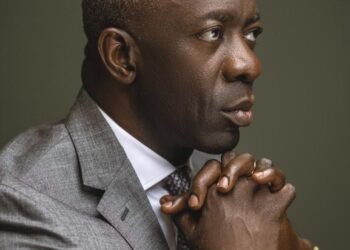











Presidential candidate of the Allied People’s Movement (APM) and Oyo State governor, ‘Seyi Makinde, has unveiled what he described as the four pillars of the Reset Nigeria Agenda, ahead of the 2027 elections.
He made the disclosure in the No 146 | September 2026 edition of his bi-monthly newsletter, “The Business of Governance.”
Makinde And The Reset Nigeria Agenda
According to him, The Reset Agenda was built around four pillars namely, economy, education, security and socio-political development.
He further stated that the agenda addressed a simple question: “What must change for Nigerians to have a fair chance to build better lives?”
The Oyo State political numero uno disclosed that the movement to reset Nigeria was not a journey that one person or a few people can undertake.
The APM presidential candidate, while encouraging all Nigerians to become a resetter, however, dropped a caveat that he was not expecting blind followership
“We are counting down to Reset Nigeria. But this is not a journey that only one person, or a few people, can undertake. That is why I am encouraging you to become a resetter.
“But I am not expecting blind followership.
“If you have been following my campaign accounts, you may have watched this video, where I made the point that Reset Nigeria is not about entitlement.
“It is about ensuring that our first 11 are in governance.
“So today, as we continue to put together our complete manifesto, I want to give you a peek into what to expect — so that when you say you are a resetter, you understand the commitment it entails.
Resetting the economy
The APM presidential candidate averred that, for millions of Nigerians, the economy was not an abstract discussion about GDP, exchange rates or inflation.
“It is what happens when you go to the market. It is how much it costs to get to work. It is whether your salary can still feed your family.
“It is whether your business can survive the cost of electricity, transport and the next government policy.
“The numbers tell their own story.
“Our economic reset will focus on creating the conditions in which people and businesses can produce, earn, invest and grow,” he added.
Governor Makinde stated that economic reset meant addressing the structural costs that make living and doing business unnecessarily expensive;
Improving infrastructure that connects people to markets and opportunities; creating a more predictable environment for businesses;
Supporting productive sectors; and ensuring that government policies enable rather than frustrate enterprise.
Using Oyo State as an example, he stated that the approach has been to identify the things that constrain economic activity and ask what the government can do to remove those constraints.
“That thinking has informed our investments in infrastructure, agribusiness and the development of our secondary cities,” he stated reassuringly.
Makinde also assured that the objective of the economic reset was not simply an economic growth on paper, but “an economy in which growth translates into better opportunities and better lives for Nigerians.”
Resetting education
On resetting the education sector, he expressed a strong opinion that Nigeria cannot build a competitive economy building its people.
“But before we can fix education, we have to be able to answer some basic questions.
“How many Nigerian children are out of school today? How many who enter Primary 1 complete basic education?
“Are children achieving the expected levels in reading and mathematics for their age? Are things getting better or worse?,” he asked.
He disclosed that one would have expected that, in 2026, the questions would have simple, current answers, adding that they don’t.
“Different official sources currently use different estimates of Nigeria’s out-of-school population, based on different datasets and definitions.
“And some of the latest national figures being used to describe what Nigerian children are actually learning still rely on assessments conducted in 2021 and 2022.
“That does not mean that no work is being done. But we cannot improve what we do not consistently measure.
“Our education system must do more than get children through the school gates.
“It must know where our children are, whether they remain in school and, most importantly, whether they are actually learning.
“Every child must count — and every child must be counted.
“In Oyo State, we have invested in education and taken steps to get more children into school and improve learning.
“But Oyo State still has out-of-school children. There is more work to do,” he admitted.
The realisation, Makinde noted, reinforced something important for him namely, that enrolment was not enough.
“Attendance is not enough. We must measure whether our children are learning and publish the results so that government can be held accountable for progress.
“The Reset Agenda will therefore look across the entire education system — foundational learning, access, teacher quality, curriculum, technical and vocational education, tertiary education, research, funding, measurement and accountability,” he assured.
Resetting security
He disclosed that security remained one of the most fundamental responsibilities of government at all levels.
“Nigerians should be able to travel, farm, trade, go to school, worship and live in their communities without constantly calculating the risk to their lives and livelihoods.
“So, is Nigeria getting safer?
“The latest comparable terrorism data gives us cause for concern.
“Between 2023 and 2025, Nigeria moved from eighth to fourth on the Global Terrorism Index, meaning our terrorism impact worsened relative to other countries.
“But security cannot be only about what government does after people have been attacked.
“It must also be about intelligence, early warning, prevention, coordination and the relationship between citizens and those responsible for protecting them.
“In Oyo State, we have seen the importance of building that chain.
“The 615 toll-free emergency line connects citizens to the state’s security response infrastructure.
“Our Security Control Room and City Watch facilities support monitoring and response, while our security architecture brings security agencies, traditional institutions and communities into the intelligence-gathering process,” he stated.
Declaring that the lesson was straightforward, he noted that information can only be useful when there is a system capable of receiving it, acting on it and getting help where it is needed.
“That principle must inform the security systems we build nationally,” he added.
Resetting the socio-political system
He admitted that Nigeria is a federation, but asked how federal is the federalism being practiced in the country.
“There are still important decisions that affect development within states that are made principally at the federal level. Mineral resources are one example. Ports are another.
“But the answer cannot simply be to move powers from Abuja to the states.
“We must ask a more fundamental question: Which level of government is best placed to make which decisions, and does it have the institutions, resources and accountability required to carry them out effectively?
“This is also the context in which I have spoken about local government autonomy, a position that has sometimes been misunderstood.
“I am not opposed to effective government at the grassroots. My argument has been that we cannot discuss financial autonomy in isolation from the structure of our federation.
“We must also be willing to examine how local governments are created, what responsibilities should sit with them and what relationship they should have with the states in which they operate,” he stated.
For him, the socio-political reset agenda of the APM, therefore, was more than transferring powers.
“It is about building a federation in which responsibilities are clear; decisions are made at the level where they can be most effective; and every level of government has institutions capable of delivering and being held accountable.
“Because moving power without building strong institutions will not solve the problem. We need both,” he added.
He disclosed that the four pillars of the reset agenda cannot be separated from one another.
“Without security, farmers cannot farm and businesses cannot invest.
“Without education, we cannot develop the people who will build a productive economy.
“Without a productive economy, poverty, unemployment and insecurity become harder to tackle.
“And without institutions that people trust, even good economic, education and security policies will struggle to deliver lasting results.
“That is why the Reset Agenda approaches them as parts of one system,” he added.
Governor Makinde further disclosed that he will, over the coming weeks, take Nigerians deeper into each of the four pillars inherent in the reset agenda.
“I will show you the evidence behind our diagnosis; the specific changes we are proposing; how we will measure whether they are working; and where my experience governing Oyo State provides useful lessons — including the things we have done well and the areas where there is still work to do.
“Because Reset Nigeria must ultimately be more than a slogan.
“It must answer the question every Nigerian has a right to ask:
“What will change — and how will that change make my life better?,” he added in the newsletter.