











Sheikh Sani Yahaya Jingir’s reported declaration that Nigeria is a “Muslim country”, paired with his instruction that citizens who reject a Muslim-Muslim presidential ticket should leave, is not merely reckless.
It is the pronouncement of a cleric displaying a profound misunderstanding of Nigeria’s constitutional order, who appears to have confused the pulpit with a political throne and the Constitution with his personal preferences. It deserves not polite disagreement, but unambiguous public condemnation.
Religious leaders who command attention carry a duty of restraint. Jingir has failed that duty spectacularly!!!
In a country whose history is scarred by religious violence, telling fellow Nigerians to pack their bags because they disagree with a political arrangement is not “strong opinion”.
Unconstitutionality of saying Nigeria is a Muslim country
It is an assault on the very idea of equal citizenship. No cleric, however influential or loud, has the authority to redefine nationality along religious lines or treat Nigerian citizenship as a conditional privilege granted by his approval.
The 1999 Constitution does not establish Islam as the state religion, nor does it establish Christianity or any other faith as such. Citizenship is not contingent upon reciting the Qur’an, attending Friday prayers or endorsing a particular political ticket.
Jingir’s claim is therefore not merely wrong it reflects a profound misunderstanding of the constitutional architecture of the country. That a man who presents himself as an Islamic scholar could so casually disregard this basic principle is deeply disturbing.
It is equally intellectually lazy to reduce Nigeria to a binary contest between Islam and Christianity. The country contains adherents of indigenous religions, other faiths and citizens who profess no organised religion at all.
More importantly, Nigeria has not conducted a recent census providing an authoritative religious breakdown. Any claim of an absolute Muslim majority deployed as a political weapon is therefore speculation presented as fact and Jingir has chosen to use that disputed proposition with maximum provocation.
The deeper problem is the elevation of creed over competence. Insecurity does not check a victim’s religion before killing. Inflation does not spare Muslim households while punishing Christian ones. Unemployment, failing infrastructure, inadequate healthcare and chronic power shortages afflict Nigerians without regard to mosque or church.
The office of the president is not a religious trophy. It is a constitutional office whose legitimate test is capacity, competence, integrity, sound judgement and a proven ability to protect and improve the lives of all citizens and not the ability to recite Qur’anic verses on demand.
A Nigerian is free to support a Muslim-Muslim ticket. Another is equally free to reject it. Both positions are legitimate in a democracy. What is illegitimate and dangerous is the assertion that disagreement amounts to forfeiture of belonging. That is the language of exclusion, not citizenship.
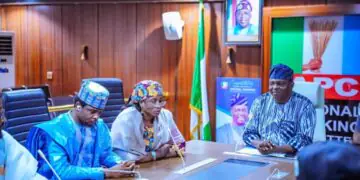
The reported presence of Kano State Governor Abba Kabir Yusuf and other public officials at the gathering compounds the concern. Elected leaders who remain silent while inflammatory religious rhetoric is delivered from a political platform cannot reasonably expect the public to regard their presence as entirely neutral.
Where public discourse slides into religious gatekeeping, those holding public office have a duty to reaffirm clearly that every Nigerian, of every faith or none, remains an equal citizen. Anything less risks giving divisive rhetoric an undeserved appearance of political legitimacy.
There is another matter that must be stated plainly. If inflammatory rhetoric of this nature is allowed to embolden hostility towards Christians or other minorities in predominantly Muslim parts of Nigeria, Jingir must be prepared to answer publicly and morally for the climate his words may help create. This is because influential figures cannot recklessly use religious language, disregard its potential consequences and then distance themselves from the atmosphere of intolerance it may encourage.
If Christians are subsequently threatened, intimidated, attacked or driven from communities because some people have been persuaded that Nigeria belongs principally to Muslims, the words of those who propagated that poisonous conception of citizenship must be examined with the utmost seriousness.
Religious authority carries responsibility. Those who have the power to inflame passions also have a duty to prevent them from becoming violence.
This is not an attack on Islam or Nigerian Muslims. Responsible Muslim scholars and community leaders should be among the first to reject the notion that Nigeria “belongs” to Muslims or that dissenters should leave.
Silence in the face of such rhetoric risks allowing the most extreme voices to define the public image of an entire faith. Nigeria has paid too high a price for religious mobilisation in politics.
Once identity becomes the primary currency of political competition, competence is discarded, accountability weakens and citizens begin to view one another through the prism of religious suspicion.
That danger is particularly acute as the country moves towards the 2027 elections.
The standard must therefore remain clear and non-negotiable -competence over creed, character over sectarian loyalty and national interest over religious arithmetic.
Sheikh Jingir is entitled to his political preference. He is not entitled to rewrite the Nigerian Constitution according to it, nor to lecture citizens on who may remain in their own country. A cleric who confuses religious influence with constitutional authority has overreached spectacularly.
•Aduwo is the Permanent Representative of the Centre for Convention on Democratic Integrity (CCDI)- a non-profit organisation with United Nations Consultative Status -to the UN on Economic and Social Council.